
Camino Muxía-Finisterre
Routes of the Muxía-Finisterre Camino
The Camino Muxía-Finisterre offers an unforgettable experience that ends at the always incredible Costa da Morte. This traditional Jacobean route passes through breathtaking landscapes and allows pilgrims to connect with nature and spirituality in a unique setting. Be sure to book your Camino de Santiago pass to experience the magic of Muxía and Fisterra while exploring this stunning area of Galicia, considered for many centuries the very end of the world.
Routes of the Muxía-Finisterre Camino
The Camino Muxía-Finisterre offers an unforgettable experience that ends at the always incredible Costa da Morte. This traditional Jacobean route passes through breathtaking landscapes and allows pilgrims to connect with nature and spirituality in a unique setting. Be sure to book your Camino de Santiago pass to experience the magic of Muxía and Fisterra while exploring this stunning area of Galicia, considered for many centuries the very end of the world.
Camino from Santiago to Fisterra
6 days / 5 nights
Starting at 375 € *
Camino from Santiago to Fisterra (extension to Muxía)
8 days / 7 nights
Starting at 500 €
The Camino a Muxía-Fisterra is an extension of the Camino de Santiago that begins in Compostela and ends at the end of the earth. Some pilgrims continue to the town of Muxía. Why do many choose to end their pilgrimage here? The answer lies in the unique experience it offers.
Booking an organized Camino de Santiago along the Muxía-Fisterra extension is becoming increasingly popular due to the deep spiritual connection with nature experienced upon reaching these sacred sites. Fisterra, according to tradition, represented the end of the known world, a place where the Celts used to perform rituals related to the sun and the sea. This symbolic and spiritual experience is a powerful reason to end the pilgrimage here. Furthermore, in Muxía, we find the Santuario da Virxe da Barca (Sanctuary of the Virgin of the Barca), where, according to legend, the Virgin Mary appeared to the Apostle Saint James to encourage him in his mission to evangelize the northern lands of the Iberian Peninsula.
Reservations for the Camino de Santiago are essential to ensure a hassle-free experience. With stunning landscapes and a peaceful atmosphere, the Camino a Muxía-Fisterra offers the opportunity to reflect, relax, and enjoy the natural beauty of Galicia’s most rugged coastline, the Costa da Morte.
The Camino de Santiago Muxía-Fisterra is a choice that will provide you with a deep spiritual connection and an enriching experience. Enjoy these final stages of your pilgrimage to the ends of the earth and find peace in these unique destinations.
Your adventure on the Camino a Muxía-Fisterra begins here! Buen Camino!
We answer some of the most frequently asked
questions about the Camino Muxía-Finisterre
Where does the Camino Fisterra start?
The Camino to Fisterra starts right where the other Camino de Santiago routes end: at the Plaza del Obradoiro, at the foot of the Cathedral of Santiago de Compostela. From there, you walk westward towards the end of the world.
Where can I stay other than hostels to do the Camino Muxía-Finisterre?
With the organized Camino to Muxía – Fisterra by Rutas Meigas, we will ensure you stay in private rooms with en-suite bathrooms. These can be hotels, guesthouses, hostels, or rural homes. Even Paradores. It all depends on the availability in each stage.
You should also note that some hostels currently have a few private rooms with bathrooms, similar to a hotel room.
How many stages are there from Santiago de Compostela to Finisterre?
From Santiago de Compostela to Finisterre, there are only four stages.
Which camino route passes through Finisterre?
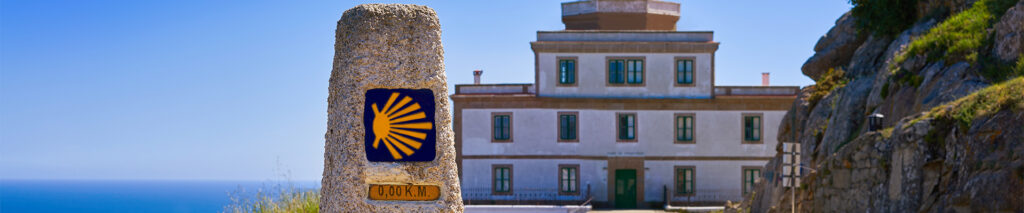
The Camino de Santiago to Finisterre ends at Finisterre, generally at the cape next to the lighthouse, where you can find the milestone marking the zero kilometer of the Camino de Santiago.
But you will also pass through Finisterre if you do the Camino de Santiago to Muxía.
Can I do the Camino Muxía-Finisterre without carrying luggage?
Of course, you can. In fact, most pilgrims now hire luggage transfer services with their Camino de Santiago. This way, they only have to walk with a light backpack containing the essentials for the day.
If you book the organized Camino Muxía – Finisterre with Rutas Meigas, it includes the transport of one piece of luggage per person, with a maximum weight of 20 kg. If you need us to carry more pieces of luggage, you can easily arrange this additional service for a small fee.
How is the Camino de Santiago to Finisterre signposted?
The Camino de Santiago to Finisterre is signposted the same way as other Camino de Santiago routes. The most common signs are, as you know, the milestones that usually indicate the distance, and the famous yellow arrows.
Still have questions about the Camino Muxía-Finisterre?