
Blog of Rutas Meigas

O Camiño do Monxe: 5-Day Ribeira Sacra hiking trail
O Camiño do Monxe is a 5-day, 4-night Ribeira Sacra hiking route in Galicia, following in the footsteps of the hermit monks who once lived in this sacred canyon. Across three hiking stages (around 60 km), walkers pass ancient monasteries, terraced “heroic” vineyards and dramatic viewpoints over the Sil canyon, finishing with a night at the Parador of Santo Estevo, a former monastery. Organised by Rutas Meigas, the route includes accommodation, breakfast and luggage transfers, from €600 per person.
Long before the first maps of the Camino de Santiago were drawn, men and women fled the world to seek God in the silence of a canyon. They settled on the steep banks of the Sil and Miño rivers, carved cells into the rock, planted impossible vineyards on near-vertical slopes, and over the centuries turned a wild territory into one of the most sacred landscapes in Galicia: the Ribeira Sacra.
From that legacy comes O Camiño do Monxe, a hiking route through the Ribeira Sacra that does more than cross spectacular scenery — stage by stage, it retraces the contemplative life of the first monks who turned rock and water into a dwelling place for faith.
The origins of the Ribeira Sacra monasteries: when silence became faith
From the earliest centuries of Christianity, hermits and monks sought refuge in the deep canyons carved by the Sil and Miño rivers as they cut through southern Lugo and northern Ourense. They dug out caves, built rock-hewn chapels and founded small monastic communities in places of almost inaccessible beauty. That ascetic calling gave the territory its name: Ribeira Sacra, the “sacred riverbank,” a name already recorded in writing since the 12th century.
Isolation wasn’t a whim. For those early anchorites, the canyon was the perfect place to disappear from the world. The vertical slate walls and river bends hid any settlement and protected a silence broken only by water. Over the centuries, those solitary cells grew into full monasteries — some Benedictine, some Cistercian — that went on to amass enormous economic and spiritual power, largely through control of the land and, above all, of wine.
It was these same monks who, generation after generation, revived the vine-growing tradition the Romans had started, carving impossible terraces into the canyon slopes to create what’s known today as heroic viticulture. Monasteries such as San Paio, Santa Cristina de Ribas de Sil and Santo Estevo de Ribas de Sil are stone witnesses to that contemplative life — and these are precisely the places that mark the stages of O Camiño do Monxe today.
Walking these trails today is, in a way, repeating what generations of monks have done for over a thousand years. Descending to the river, climbing the hillside, or pausing at a viewpoint feels like the landscape itself becoming a form of prayer.
O Camiño do Monxe in 5 Days: for those without two weeks to spare
Not everyone can take two weeks off to complete O Camiño do Monxe’s full 9-day route. That’s why this 5-day, 4-night version exists — designed for anyone who wants to experience the essence of Ribeira Sacra hiking in fewer stages. Three full days of walking, around 60 km in total, two emblematic monasteries, terraced vineyards perched over the void, and a final night sleeping in a National Parador housed in a thousand-year-old monastery.
The difficulty level is moderate, no previous multi-day trekking experience is required, and Rutas Meigas takes care of everything else. Our hiking experience includes accommodation, breakfast and luggage transfer between stages, so the only thing you need to worry about is putting one foot in front of the other.
Day by day: canyons, vineyards and monasteries
The route begins in Castro Caldelas, a village dominated by an imposing medieval castle that already hints at the grandeur of the landscape to come.
The first hiking stage descends toward the Val de Abeleda, home to the silent ruins of the Monastery of San Paio, surrounded by some of the most respected wineries of the Ribeira Sacra D.O. The stage ends at A Fábrica da Luz, a former hydroelectric plant converted into accommodation beside the famous walkways over the River Mao — a place where the sound of water replaces every other noise.
On the second day we walk alongside the River Sil, through the spectacular terraces of heroic viticulture. Passing the incredible Balcones de Madrid viewpoint, the trail leads to the Monastery of Santa Cristina de Ribas de Sil, and shortly after to the viewpoint known as A Mirada Máxica — one of those spots where the canyon opens up and, for a moment, time seems to stand still.
On the third and final hiking day, the Sil continues to set the pace, this time from above. We’ll pass the O Cotarro viewpoint, the highest in the canyon, along with the viewpoints of Cabezoá, A Columna, Vilouxe and Pé do Home, each offering some of the most breathtaking panoramas in all of Galicia. The route ends at the Monastery of Santo Estevo de Ribas de Sil, today a National Parador, where you’ll sleep among the very stones that once sheltered its monks.
Each stage is designed so the walking pace matches the rhythm of the landscape: cool mornings among chestnut and oak trees, open midday hours through vineyards, and the last hours of daylight saved for the great viewpoints, when the sun sets over the Sil canyon and the vine terraces turn gold. It’s no coincidence that many hikers describe these sunsets as the true highlight of the route — even above the monasteries themselves.
What’s included in this Camiño do Monxe Experience
This version of O Camiño do Monxe includes accommodation with private bathroom, breakfast, luggage transfer between stages (maximum 20 kg per bag), transfers according to the itinerary, a 24-hour emergency line, maps and GPS tracks for each stage, pilgrim credential and travel insurance. Prices start from €600 per person in a double room.
Who is the 5-Day Camiño do Monxe for?
O Camiño do Monxe in 5 days is designed both for experienced hikers looking for a new Galicia hiking route to complete in a short time, and for anyone tackling a multi-day route for the first time who wants to start with a shorter one. Only a moderate fitness level is required. No technical experience or previous long-distance walking is needed — just the desire to walk and let yourself be surprised by one of the most magical corners of inland Galicia.
Frequently Asked Questions about O Camiño do Monxe
How many days does the short version of O Camiño do Monxe take?
This version lasts 5 days and 4 nights, with 3 full days of hiking.
What’s the total distance of the route?
The total distance is around 60 km, split across three stages of between 19 and 21 km each.
How difficult is it?
The difficulty is moderate. No technical knowledge or previous long-distance experience is required — just a reasonable level of fitness.
Where does the route start and finish?
The route starts in Castro Caldelas and ends at the Monastery of Santo Estevo de Ribas de Sil, today a National Parador.
Can you reach the starting point by public transport?
You can take the train to Ourense and then a private transfer to Castro Caldelas.
What’s included in the price from €600?
It includes accommodation with private bathroom, breakfast, luggage transport, transfers according to the itinerary, map, credential, stage tracks and travel insurance.
Is this route suitable for someone who has never done a multi-day trail before?
Yes, it’s an ideal option for those starting out in multi-day trekking, since Rutas Meigas handles the logistics, accommodation and luggage.
What’s the best time of year for Ribeira Sacra hiking on O Camiño do Monxe?
You can hike O Camiño do Monxe all year round, though spring and autumn offer the most pleasant walking conditions. In autumn, the whole Ribeira Sacra area turns incredible colours.

Ribeira Sacra Monasteries: the story behind O Camiño do Monxe
The Ribeira Sacra is home to more than twenty historic monasteries, though only a handful survive today. Seven mark the stages of O Camiño do Monxe’s 9-day route — San Paio de Abeleda, Santa Cristina de Ribas de Sil, Santo Estevo de Ribas de Sil (now a National Parador), San Pedro de Rocas (Galicia’s oldest monastic site, dating to 573), Santa María de Xunqueira de Espadañedo, Santa María de Montederramo and San Juan de Camba — while the 5-day route, a shorter Ribeira Sacra hiking option, passes three of them: San Paio de Abeleda, Santa Cristina de Ribas de Sil and Santo Estevo de Ribas de Sil.
In our last post we told the story of the monks who gave the Ribeira Sacra its name. Today it’s time to focus on the stone protagonists themselves — the monasteries that, for over a thousand years, have shaped the spiritual, economic and scenic pulse of this region.
Each one has its own history, its own founding century still debated by historians, and its own more or less direct connection to the hiking routes that cross the area, such as O Camiño do Monxe, and also to the **Camino de Santiago**, since part of the **Camino de Invierno** also runs through areas of the Ribeira Sacra.
San Paio de Abeleda: the Monastery that refuses to disappear
This is the first monastery you’ll find on O Camiño do Monxe, on both the 5-day and 9-day routes, between Castro Caldelas and Fábrica da Luz, on the way to Val de Abeleda.
Historians disagree on its origins. Some place it in the 10th century, when the family of the nobleman San Rosendo is documented as the landowner; others prefer to date it to the 12th century, when the church still standing today was built.
What we do know for certain is its decline. Mendizábal’s confiscation laws in the 19th century left it without a religious community, though its church remained a parish. In 1872 it was acquired by the House of Alba, and in 1972 it closed permanently to worship.
Today, San Paio de Abeleda is a Romanesque ruin of strange beauty, its original doorway and capitals — carved with plant and animal motifs — still visible, surrounded by vineyards and silence.
Thanks to local non-profit associations, the site is kept minimally preserved, preventing it from disappearing altogether.
Santa Cristina de Ribas de Sil: romanesque architecture embracing the river
The second day of O Camiño do Monxe leads to one of the most admired Romanesque complexes in all of inland Galicia: the Monastery of Santa Cristina de Ribas de Sil, in the Merilán chestnut grove beside the River Sil, in the municipality of Parada de Sil. Its origins are, again, uncertain. Some documents suggest a community of hermits was already present in the 9th or 10th century, while the current church — one of the finest examples of rural Galician Romanesque — dates from the late 12th to early 13th century.
For centuries it was an independent Benedictine monastery, until in 1508 it was reduced to a priory dependent on Santo Estevo de Ribas de Sil, following a monastic reform that reorganised much of Galicia’s monastic life. That change in status marked the start of its decline. The confiscation of 1835 turned it into a simple, privately owned farm.
Today the church, the tower and part of the cloister survive, minimally restored and open to the public. You can still see the so-called armarium claustri — niches in the wall where the monks kept their books — along with capitals carved with plant motifs that have survived eight centuries intact.
Nearby, several viewpoints, such as Cabezoás, let you take in the Sil canyon from above before continuing the route.
Santo Estevo de Ribas de Sil: from refuge of nine bishops to National Parador
The third stage of O Camiño do Monxe in 9 days ends at one of the great icons of the Ribeira Sacra: Santo Estevo de Ribas de Sil. On the 5-day route, this is the high point and the finish line of the three hiking stages.
It’s the most monumental monastery in the whole Ribeira Sacra. Tradition attributes its origins to San Martiño de Dumio in the 6th century, although the first documented reference dates to the year 921, when King Ordoño II handed the site — then in ruins — to Abbot Franquila to rebuild monastic life there.
The monastery became famous in the 10th and 11th centuries thanks to a curious legend: nine Galician bishops, some fleeing the Muslim advance and others simply seeking a peaceful retreat, settled here to spend their final years. On their deaths, each left his bishop’s ring as an offering to the monastery, and all were buried in what’s now known as the Cloister of the Bishops, today one of the building’s most photographed corners.
After the reform of the Catholic Monarchs in 1499, the monastery passed to the Congregation of San Benito and began a deep architectural transformation that continued until the 18th century, giving rise to the three cloisters that coexist under one roof today: Romanesque, Gothic and Renaissance. Declared a Historic-Artistic Monument in 1923 and a Site of Cultural Interest in 1985, the building was restored in the late 20th century and reopened in 2004 as a National Parador de Turismo, with 77 rooms spread across its former cloisters.
This is where those hiking O Camiño do Monxe in 5 days spend their final night — or one of the intermediate nights if hiking O Camiño do Monxe in 9 days. Yes, you’ll sleep among the very stones that once sheltered bishops, monks and hermits.
San Pedro de Rocas: the cradle of Galician Monasticism
On the 5-day route, San Pedro de Rocas falls outside the walking trail, while on O Camiño do Monxe in 9 days it becomes the highlight of the fourth stage, between Santo Estevo and Esgos. After a steep climb from Santo Estevo, the trail reaches this extraordinary site.
Carved directly into the granite rock of Mount Barbeirón, in the municipality of Esgos (Ourense), San Pedro de Rocas is considered the oldest monastic complex in Galicia and one of the oldest in Spain. A founding inscription found at the site itself, now kept at the Archaeological Museum of Ourense, dates its origins to the year 573, when five hermit monks withdrew here to live a life of solitary prayer.
Its three naves, carved straight into the rock, lack the elegance of later Romanesque temples — they’re rough, primitive, almost earthbound. And that roughness is precisely its greatest treasure, because here you can literally touch the skin of the oldest monasticism on the Iberian Peninsula.
The site was declared a Historic-Artistic Monument in 1923 and today houses a Ribeira Sacra interpretation centre in the former 17th-century prior’s house.
Santa María de Xunqueira de Espadañedo: a Stop with medieval flavour
The fifth stage of O Camiño do Monxe in 9 days, between Esgos and Maceda, takes you to one of the lesser-known monasteries of the Ribeira Sacra: Santa María de Xunqueira de Espadañedo. Its history has left a fascinating mix of architectural styles, from Romanesque to Baroque.
This Cistercian monastery began as an early medieval community that became Benedictine in the 12th century. By the end of that same century it joined the Cistercian order, linked to the nearby monastery of Montederramo.
From the medieval period, its basilica-plan church survives, with three naves and semicircular apses.
The current altarpieces also reflect the monastery’s evolution and the influence of the Counter-Reformation. The iconography centres on the Virgin Mary and the celebration of Western monasticism, represented by Saint Benedict of Nursia and Saint Bernard in the Baroque altarpieces.
Santa María de Montederramo: the spiritual heart of the Ribeira Sacra
The sixth stage of O Camiño do Monxe in 9 days runs from Maceda to Montederramo and ends at the Monastery of Santa María de Montederramo.
Considered the spiritual heart and one of the most important monasteries in the whole Ribeira Sacra, Montederramo marks the long route’s great leap into the interior of the region. The monastery’s documented history goes back to a charter dated 21 August 1124, granted in Allariz by Doña Teresa of Portugal. In it, the infanta granted Abbot Arnaldo and the Benedictine monks accompanying him a place called Rivoira Sacrata (or Roboira Sacrata) to found a monastery there, also reserving the monks’ right to relocate if they considered it more convenient. That first settlement wasn’t in today’s town of Montederramo, but near Leboreiro, in the area of Seoane Vello, under the patronage of Saint John and Benedictine observance; only later, once integrated into the Cistercian order, did the monastery take the name Santa María and move to its final location. You’ll find a fragment of this founding document in your Carta Sacra.
After following the Sil and visiting some of its best-known monasteries, the route continues into a territory where the monastic presence once again takes centre stage.
San Juan de Camba: the last monastery before closing the loop
The seventh and final stage of O Camiño do Monxe in 9 days runs from Montederramo back to Castro Caldelas. Before returning to the starting point, the trail passes the Capela das Neves and the Monastery of San Juan de Camba.
It’s the last of the route’s seven monastic stops and the one that closes a circular itinerary that has crossed much of the Ribeira Sacra’s historic territory.
Santa María de Ferreira de Pantón: one more Monastery to extend the experience
A short drive from Monforte de Lemos lies another of the Ribeira Sacra’s great monasteries, Santa María de Ferreira de Pantón, popularly known as the Monastery of the Bernardas. Its first documented references date back to the 10th century, when it was a family-run Benedictine monastery; two centuries later it joined the Cistercian order, and its Romanesque church was built in the 12th century, while the cloister dates from the 15th. The remaining buildings were added in the 18th century.
What makes this monastery unique isn’t just its architecture but its continuity — it’s the only enclosed community of nuns in all of Galicia to have maintained religious life uninterrupted from its founding to today, untouched by Mendizábal’s confiscation laws. The Cistercian nuns who still live there make traditional sweets and liqueurs, and welcome visitors to see part of the grounds and their beautiful Romanesque church, declared a National Monument in 1975.
If you want to extend your experience beyond the O Camiño do Monxe route, Ferreira de Pantón remains an excellent complementary visit.
FAQs about the Ribeira Sacra Monasteries and O Camiño do Monxe
How many monasteries are there in the Ribeira Sacra?
It’s estimated that there were once more than twenty monasteries and priories in the region, though today only a few remain in good condition or are open to visitors.
How many monasteries does O Camiño do Monxe in 9 days pass?
Seven monasteries form part of the seven-stage route: San Paio de Abeleda, Santa Cristina de Ribas de Sil, Santo Estevo de Ribas de Sil, San Pedro de Rocas, Santa María de Xunqueira de Espadañedo, Santa María de Montederramo and San Juan de Camba.
And how many monasteries does the 5-day route pass?
Three: San Paio de Abeleda, Santa Cristina de Ribas de Sil and Santo Estevo de Ribas de Sil, one for each hiking stage.
Which is the oldest monastery in the Ribeira Sacra?
San Pedro de Rocas, in Esgos, whose origins date back to the year 573 according to the founding inscription kept at the Archaeological Museum of Ourense.
Can you sleep in a Ribeira Sacra monastery?
Yes. The Monastery of Santo Estevo de Ribas de Sil is now a National Parador de Turismo. On the 5-day route you spend your last night there, and on the 9-day route it’s part of the third stage.
What’s the main difference between the 5-day and 9-day O Camiño do Monxe?
The 5-day route concentrates the journey into three hiking stages and three monasteries around the Sil. The 9-day version includes seven stages passing through seven monasteries.
Is there a Ribeira Sacra monastery with active religious life today?
Yes. Santa María de Ferreira de Pantón, home to Cistercian nuns known as the Bernardas, has kept monastic life going uninterrupted since the Middle Ages.
Is entry to these monasteries free?
It depends on each site. For example, San Paio de Abeleda and San Pedro de Rocas can be visited freely, while Santa Cristina charges a small symbolic entrance fee.
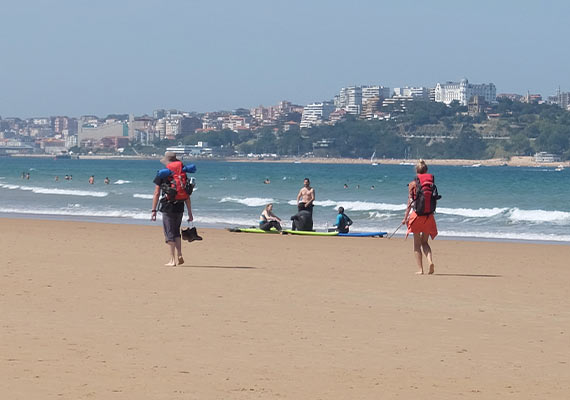
Which Camino de Santiago route is best for walking in the heat?
July and August are the months when many pilgrims, taking advantage of the summer holidays, follow the yellow arrows towards Compostela. They’re also the hottest months. And although all routes of the Camino de Santiago (Saint James Way) can be walked in summer, not all of them suffer the high temperatures in the same way.
If summer is the only time you have available, choosing the right route can make all the difference in enjoying the Saint James Way as it deserves.
That’s why today we’re telling you which Caminos are more bearable in high temperatures, which ones you should avoid, and a few tricks for coping with any of them.
Why the heat feels so different depending on the route
The different routes of the Saint James Way are very long and cross such wide geographic areas that climate variations are only natural. Walking along the Cantabrian Sea is not the same as crossing the Castilian plateau without any shade. Three factors make the difference: proximity to the coast, which softens temperatures thanks to the Atlantic breeze; altitude and terrain, since mountain and forest areas offer shade for much of the day; and the length of the route, because fewer stages mean fewer days of accumulated heat exposure.
The coolest routes: the power of the Atlantic breeze
One very effective way to beat the heat on the Camino de Santiago is to walk beside the sea. Galicia’s coastal routes are, year after year, the most recommended for summer.
- Portuguese Coastal Way: runs right along the coastline, with the Atlantic breeze cooling the walk and several beaches for a dip at the end of the stage. It’s probably the most rewarding option in summer.
- Northern Way (Camino del Norte): follows the entire Cantabrian coast before heading into Galicia, keeping milder temperatures than inland routes for much of its length, with cliffs, riverside woodland and coastal villages.
- Spiritual Variant and Father Sarmiento Route: both move through the Rías Baixas, with stretches along the sea and the chance to stop at beaches such as Combarro, O Terrón or A Lanzada — ideal for cooling off mid-stage.
The English Way: the short option to escape the heat
If your goal is minimising days of heat exposure, the English Way (Camino Inglés) is one of your best bets: with just 5–6 stages from Ferrol or A Coruña, it lets you complete the pilgrimage in just over a week, greatly reducing the accumulated strain of the hottest days. Much of the route also runs through eucalyptus and oak woodland that offers shade.
Routes to avoid in midsummer: the Meseta and the Vía de la Plata
At the opposite extreme are the inland routes that cross vast plains with almost no shade. The stretch of the French Way (Camino Francés) that crosses the Meseta of Castilla y León, between Burgos and León, is among the toughest in summer: mile after mile of open fields where the sun beats down directly for much of the day.
It’s even harder if you walk the Vía de la Plata from its starting point in the south of the peninsula. This is the Jacobean route where extreme temperatures are most easily reached in July and August. If you have no choice but to walk it in those months, one alternative is to join the Vía de la Plata from Ourense, avoiding the toughest southern stretch.
Tips for coping with the heat on any Camino
Whichever route you choose, remember it’s summer, and heatwaves are becoming more common even in the north. So it’s always worth following a few tips:
- Start walking at dawn: getting ahead of the heat and reaching your destination by mid-morning is, by far, the most effective trick on any route.
- Lighten your backpack: with Rutas Meigas, luggage transfer for one bag is already included, and you can add more if you need to. But walk with a small daypack carrying only what’s essential for that stage.
- Choose stages with a river or beach: many stretches of the Camino, even inland ones, pass by swimming spots — check ahead of each stage and make the most of the stop.
- Stay hydrated constantly: don’t wait until you’re thirsty, and always carry sun protection and something to cover your head.
Frequently asked questions about walking the Camino de Santiago in the heat
Which is the best Camino de Santiago to walk in summer heat?
The Portuguese Coastal Way and the Northern Way are the most recommended in summer, since they run along the sea and benefit from the Atlantic breeze, which softens temperatures compared with inland routes.
Which Camino de Santiago should you avoid in midsummer because of the heat?
The Vía de la Plata between Seville and Galicia, and the stretch of the Camino Francés that crosses the Meseta of Castilla y León between Burgos and León, are the toughest in summer due to their long, shadeless plains and the extreme temperatures they can reach.
Is it better to walk the Camino de Santiago along the coast or inland in summer?
In summer, the coast is preferable. The Atlantic breeze softens temperatures and lets you cool off at beaches near the route, which isn’t always possible on inland Caminos.
What time is best to walk in summer to avoid the heat?
It’s best to start the stage at dawn and reach your destination by mid-morning, before temperatures peak between 1pm and 5pm.
Which Portuguese Way is better in summer, the Coastal or the Central route?
The Portuguese Coastal Way is more recommended in summer than the Central route, since it runs right along the coastline with sea breeze and beaches to swim at, while the Central route runs inland with fewer ways to cool off.
Is it advisable to walk the Northern Way in summer?
Yes. The Northern Way follows the Cantabrian coast and keeps milder temperatures than inland routes, with stretches of cliffs, forest and coastal villages to cool off in.
What short Camino can you walk in summer without suffering too much heat?
The English Way, with only 5–6 stages from Ferrol or A Coruña, is one of the best options for reducing days of heat exposure, and much of the route runs through shaded woodland.
The best Way to beat the heat
In the end, the best Camino in the heat is the one you prepare for best. Check whether there’s shade along the route, places to cool off or swim, and follow the tips above — which are really just a bit of “sentidiño” (Galician good sense) applied to the trail.
At Rutas Meigas we can help you plan your Camino de Santiago with the heat in mind, so summer becomes an ally rather than an obstacle on your pilgrimage.
Buen Camino!
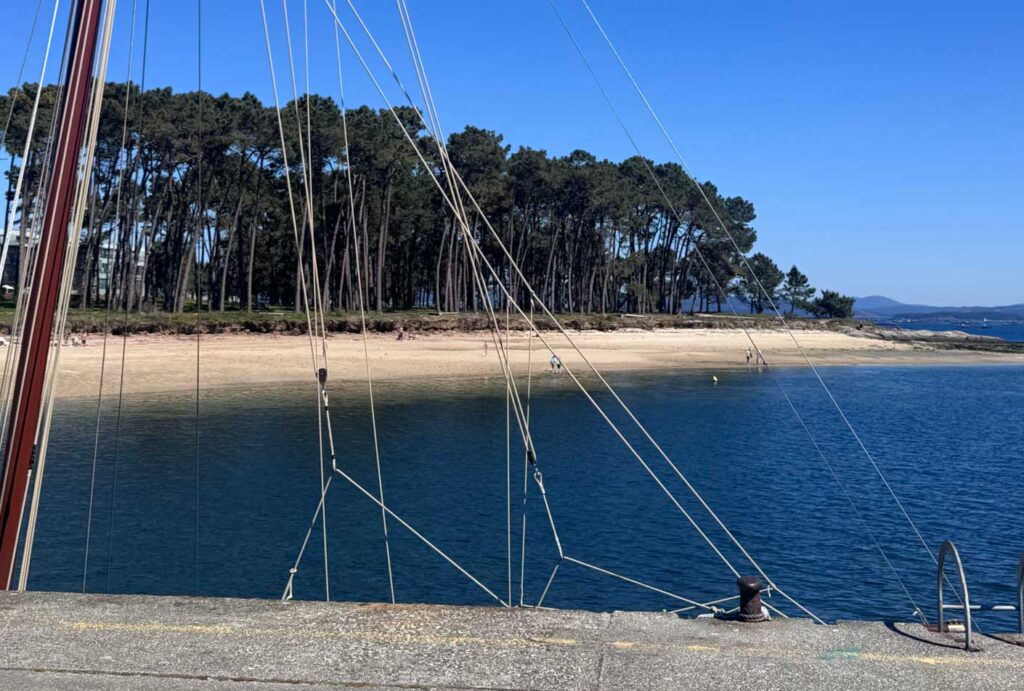
Best beaches along the Camino de Santiago in Galicia
Some people picture the Saint James Way (Camino de Santiago) as a route through forests, villages and inland hamlets. And most of the time, it is. But in Galicia, the Way also smells of sea salt.
If you walk the Saint James Way in summer, you’ll find long stretches along the Galician coast — the longest in Spain — where you can take a dip and cool off after many kilometres on foot.
Where to take a dip without leaving your route on the Way
Several variants of the Saint James Way skirt estuaries, sandy shores and small coves where the pilgrim can pull off their boots, dip their feet in the water for a while, and continue their route with their batteries recharged. Or take a proper swim, of course.
Portuguese Coastal Way: the beaches of the Rías Baixas
This variant, which follows the Atlantic coastline from Portugal to Compostela, passes close to some of the most iconic summer beaches in Galicia. The Portuguese Coastal Way offers several excellent stretches of sand without straying far from the yellow arrows.
- Area Grande (A Guarda): right in the town centre of A Guarda, this pleasant beach is surrounded by restaurants — perfect for relaxing at the end of a stage, or before starting the next one if you’re an early-morning swimmer.
- Playa América, Panxón and Patos (Nigrán): after the medieval bridge at A Ramallosa, the route passes the magnificent sands of Panxón and Playa América. A little further on lies Praia de Patos. All three are highly sought-after beaches during the Galician summer.
- Praia de Samil (Vigo): shortly after, the route reaches the Samil inlet, Vigo’s beach of choice, preceded by other smaller but equally beautiful stretches of sand — especially since this area offers superb views of the Cíes Islands.
- Praia de Cesantes (Redondela): a beautiful beach over 2,400 metres long, with the added bonus of the incredible scenery of San Simón Bay, the Rande Bridge in the background, and the mysterious Isla de San Simón in between.
English Way: between city waves and quiet coves
The English Way sets off from A Coruña or Ferrol and, although it’s a shorter route, it doesn’t lack for sea moments.
- Orzán and Riazor beaches (A Coruña): pilgrims who choose the variant starting in A Coruña begin their stage with waves breaking alongside them, over a thousand metres of urban sand, plenty of facilities, and the Tower of Hercules in the background.
- Playa de la Magdalena (Pontedeume): you’ll pass this beach on the English Way if you set off from Ferrol, on the second stage, between Neda and Pontedeume.
Spiritual Variant: granaries and coves leading to the Traslatio
The Spiritual Variant of the Portuguese Way branches off in Pontevedra to recreate, several stages later, the sea voyage that carried the remains of the Apostle Saint James. Before boarding, pilgrims pass several beaches of the Rías Baixas.
- O Terrón and As Sinas in Vilanova de Arousa: Praia de O Terrón is one of the beaches pilgrims reach as they approach Vilanova, on the outskirts of town — ideal for a calm, family atmosphere, with gentle waters and golden sand. Surrounded by lush vegetation, it offers panoramic views over the estuary, calm and clear waters perfect for swimming, and activities such as kayaking and paddle surfing, plus a seafront promenade. Past the town centre lies Praia de As Sinas, with beach bars nearby and areas for a stroll.
- Illa de Arousa: if you feel like crossing the bridge (2 km from Vilanova), Illa de Arousa boasts some of the most spectacular beaches on the whole estuary: playa das Margaritas, playa dos Petóns and playa dos Espiños, as well as playa de Lameira, Lontreira and Punta Carreirón, with turquoise waters and white sand. And if you still have energy to walk a little further, you can reach Punta Cabalo, home to the lighthouse. Beside it sits a small beach, and a larger one that is among the prettiest on the island: Playa Area da Secada.
Father Sarmiento Route: the beachiest of them all
Although it isn’t an official Camino de Santiago, if you don’t want to lose sight of the sea for a moment, the Father Sarmiento Route is the Galician variant with the most consecutive beaches. It recreates the coastal itinerary the Benedictine friar walked in 1745 between Pontevedra and Santiago, staying close to the Pontevedra and Arousa estuaries the whole way.
It runs through places like Sanxenxo, Portonovo and O Grove, with countless beaches (Silgar, Montalvo, Paxariñas…), many of them Blue Flag beaches. But the queen of them all is A Lanzada, one of the best Atlantic beaches in Europe, nearly 3 kilometres long and much loved by surfers. Precisely because of this, watch out for the waves here — this isn’t the sheltered estuary, it’s the open sea, and the Ocean has a character of its own.
Again, if you’re walking this route — just as on the Spiritual Way — you can make a side trip to Illa de Arousa.
Way to Fisterra and Muxía: the Costa da Morte has beaches too
The Jacobean extension towards Fisterra and Muxía, starting from Cee, reveals more stretches of sand.
- Estorde, Sardiñeiro and Langosteira: between Corcubión and Fisterra, the Way runs almost right along the sea, linking these three beaches. Langosteira, the best known, was once where pilgrims bathed before reaching the cape to purify themselves ahead of the Lighthouse. It remains a classic stop today.
- Mar de Fóra and O Rostro (Fisterra): already in Fisterra itself, these two beaches open onto the Atlantic and have a wilder character, with regular swell and less shelter from the wind. They’re also two regular surfing spots on the Costa da Morte.
- Praia de Lires: on the stage between Fisterra and Muxía, the Way descends to this beach on Galicia’s smallest estuary — one of the quietest, least-crowded corners of the entire Jacobean extension.
- Playa de Lourido (Muxía): on the final stretch towards the sanctuary of A Virxe da Barca, the Way skirts this roughly 300-metre stretch of fine sand, flanked by a dune system, just before entering the village.
- Playa de Nemiña: it lies outside the official route, but for anyone with an extra day in Muxía, it’s a highly recommended excursion — considered one of the most beautiful beaches in Galicia.
Frequently asked questions about the beaches on the Saint James Way
Which beaches are along the Saint James Way in Galicia?
The Camino de Santiago passes several beaches in Galicia, such as Playa América and Samil on the Portuguese Coastal Way, Riazor and Orzán on the English Way, Combarro and O Terrón on the Spiritual Variant, and A Lanzada, Silgar and Montalvo on the Father Sarmiento Route.
Which variant of the Saint James Way has the most beaches?
Without being an official Camino, the Father Sarmiento Route is the Galician variant with the most consecutive beaches. It hugs the coastline between Pontevedra and Santiago, passing A Lanzada, Silgar, Montalvo, Paxariñas and the beaches of Illa de Arousa and Vilanova de Arousa, most of them Blue Flag beaches.
Can you walk the Camino de Santiago and swim in the sea?
Yes. On the Portuguese Coastal Way, the English Way, the Spiritual Variant and the Father Sarmiento Route, there are stretches that run right alongside beaches, so it’s entirely possible to plan your stage around a swimming stop without straying far from the route.
Which beach is near Santiago de Compostela to cool off after the Camino?
If you have a car, the closest option to Santiago would be the beaches around Noia. The beaches of Vilagarcía de Arousa (Compostela and La Concha), located in the town centre, are reachable by train — which possibly makes them the most convenient option once you finish the Camino de Santiago.
Which beaches does the Portuguese Way pass?
The Portuguese Coastal Way passes Playa América and Panxón, in Nigrán, and Praia de Samil, in Vigo, where you can spot the Cíes Islands before the route heads into the city.
What beaches are on the English Way?
Those setting off from A Coruña begin the stage right next to Riazor and Orzán beaches, in the heart of the city. From Ferrol, the route passes Playa de la Magdalena, in Pontedeume — a much quieter alternative.
Which beaches do you see on the Spiritual Variant of the Camino de Santiago?
The Spiritual Variant passes the beach of Combarro and, once in Vilanova de Arousa, O Terrón and As Sinas, right before boarding for the Traslatio. Two kilometres away, Illa de Arousa offers turquoise-water beaches such as das Margaritas or dos Petóns.
Every pilgrim, their own beach
In the end, there’s no single way to experience the Saint James Way (Camino de Santiago), and no single beach to recommend either. You might prefer the urban buzz of Riazor, the calm, family feel of O Terrón, the impossible blue of Illa de Arousa, or the vastness of A Lanzada. Whichever variant you choose, in summer, the sea is never too far away in Galicia.
Buen Camino!
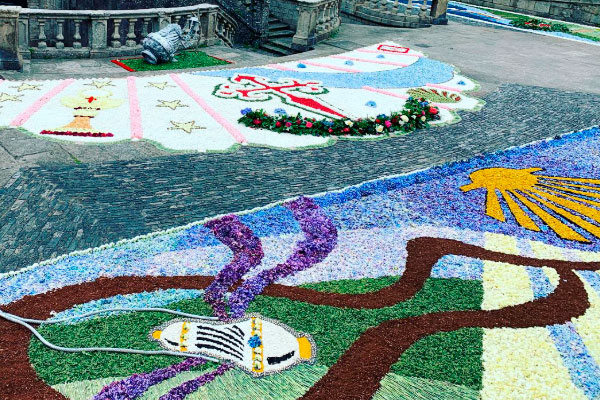
July 25, Feast of St. James, why it’s celebrated and how
July 25 is the Feast of St. James the Apostle, Galicia’s most important religious and civic holiday. It marks the day St. James began his eternal life after his martyrdom, and it’s celebrated in Santiago de Compostela with a solemn Mass, the swinging of the giant botafumeiro incense burner, fireworks, and two weeks of festivities. When July 25 falls on a Sunday, the Catholic Church declares a Holy Year, a rare honor shared only by Santiago de Compostela, Rome, and Jerusalem — the next one falls in 2027.
Every July 25 is etched into the memory and calendar of Galicians in general, and of picheleiros in particular. On this date, our city hosts one of the oldest and most solemn celebrations still observed today.
At Rutas Meigas, every year we walk alongside thousands of pilgrims arriving in Santiago de Compostela via the various Camino de Santiago routes. And we know that few experiences hit harder than reaching the end of the Camino during the Feast of the Apostle — or better yet, during one of the rare Holy Years that occur only a handful of times per century. The next one, as it happens, is 2027.
Why we Celebrate St. James the Apostle on July 25
St. James — called “the Greater” to distinguish him from another apostle of the same name — was one of the twelve disciples of Jesus of Nazareth and, alongside his brother John and Peter, one of his closest companions. Christian tradition places his martyrdom in Jerusalem around the year 44 AD, beheaded by order of Herod Agrippa I, making him the first apostle known to have been martyred according to written record. July 25 doesn’t actually commemorate his death, but rather the beginning of his eternal life — which is why it’s a feast day for Christians.
According to tradition, after his death his disciples Theodore and Athanasius recovered his body and carried it by sea to the shores of Gallaecia, present-day Galicia, where he had preached during his lifetime. He was buried there, and his tomb lay forgotten for centuries — until the 9th century, when a hermit named Pelagius (Paio), guided by strange lights over a forest, discovered the remains. The find was confirmed by Bishop Theodomir and by King Alfonso II “the Chaste” of Asturias, who traveled to the site and, according to tradition, became history’s first pilgrim.
Over that “field of stars”, the city we know today would eventually rise.
From forgotten tomb to holy city: the birth of the Camino de Santiago
The discovery of the tomb completely transformed that corner of northwestern Spain. Within a couple of centuries, Compostela went from a modest settlement to one of the three great pilgrimage destinations of medieval Christianity, alongside Rome and Jerusalem. Thousands of pilgrims from across Europe began walking what we now call the Camino de Santiago — a network of routes that drove the construction of bridges, hospitals, monasteries, and churches, and helped shape much of medieval Europe.
That universal appeal explains why, centuries later, UNESCO designated the Camino de Santiago a World Heritage Site, and why every July 25, thousands of people from around the world still converge on the same square to mark the same date that’s been celebrated for over a thousand years.
The Holy Year of Compostela
If July 25 is already a special date every year, there’s one circumstance that elevates it to an entirely different level: when it falls on a Sunday. When that happens, the Church declares a Holy Year of Compostela (Año Santo Compostelano), a unique privilege granted only to Santiago de Compostela, Rome, and Jerusalem.
This privilege dates back to 1122, when Pope Calixtus II granted Compostela the honor of celebrating a Jubilee Year whenever the Feast of the Apostle fell on a Sunday. Decades later, in 1178, Pope Alexander III confirmed and made this privilege permanent through the papal bull Regis Aeterni, formally placing Compostela on equal footing with Rome and Jerusalem as a destination for plenary indulgence.
Because of how the calendar and leap years work, this coincidence follows a repeating pattern of 6, 5, 6, and 11 years, producing fourteen Holy Years per century. In recent decades, Compostela Holy Years were celebrated in 1993, 1999, 2004, 2010, and 2021 — the latter extended into 2022 by Pope Francis due to the COVID-19 pandemic. Following that same pattern, the next Holy Year will be 2027, followed by 2032.
During Holy Years, Santiago Cathedral opens its Holy Door (Puerta Santa), located in Quintana Square, in a ceremony held on New Year’s Eve of the preceding year, when the archbishop symbolically strikes with a silver hammer what, for centuries, was a bricked-up wall. Passing through the Holy Door, together with confession, communion, and prayer for the Pope’s intentions, allows pilgrims to obtain the plenary indulgence — a full remission of the temporal punishment for already-confessed sins, which for many believers is the ultimate purpose of their pilgrimage.
How Santiago de Compostela celebrates the Feast of the Apostle
The Feast of the Apostle isn’t limited to a single day. For nearly two weeks, Compostela fills with concerts, exhibitions, street parades, and outdoor performances that build in intensity toward the two biggest days: July 24 and 25.
Novena of St. James the Apostle
From July 15 to 23, at 7:30 PM each evening, the Novena of St. James the Apostle is held at the Cathedral. On July 24, ahead of the grand solemn Mass the following day, the Archbishop of Santiago de Compostela, His Excellency and Most Reverend Francisco José Prieto Fernández, will preside over Solemn Vespers. On that day, the Pilgrim’s Mass is celebrated at 8:30 PM, an hour later than usual.
During this period, Pilgrim’s Masses are also held daily at 1:00 PM, 4:00 PM, 5:00 PM, 6:00 PM, and 7:30 PM.
Fogos do Apóstolo: the night that lights up the city
The night of July 24 is, for many picheleiros (locals from Santiago) and visitors, the true heart of the festival. This is the Fogos do Apóstolo (“Fires of the Apostle”) — a light, sound, and fireworks show that draws tens of thousands of people to Obradoiro Square and other iconic spots across the city. Its documented origins date back to the 16th century, when the square was lit with colored candles to mark the start of the celebration. In the 17th and 18th centuries, that lighting evolved into the burning of a large pyrotechnic “castle” designed to mimic the Cathedral’s façade.
For heritage-preservation reasons, since 2020 the fireworks display is no longer staged on the Cathedral façade itself. Today the fireworks are launched from several points around central Santiago — typically the Alameda park, the Fontiñas Steps (Carlomagno Park), and the Cidade da Cultura de Galicia.
The Apostle’s Mass, the National Offering, and the Botafumeiro
On July 25, religious solemnity takes center stage. The Apostle’s Mass is celebrated in the Cathedral, usually presided over by the Archbishop of Santiago, during which the traditional National Offering to the Apostle takes place — a ceremony dating back to 1643, when King Philip IV instituted an offering of a thousand gold escudos to the patron saint of Spain.
Today, the King of Spain, a representative of the Royal Household, or a royal delegate travels to Compostela each year to present this offering on behalf of the nation. During the Mass, it’s also customary for the famous botafumeiro to swing — the giant incense burner that sweeps across the Cathedral’s transept, filling the church with a cloud of incense in what is, for pilgrims and visitors alike, one of the most unforgettable images of the entire Camino de Santiago.
Galicia Day
July 25 is also Galicia’s National Day, the region’s official civic holiday, which takes advantage of the Apostle’s feast day to hold official ceremonies, cultural events, and public demonstrations tied to Galician identity.
On this single day, Compostela brings together religious solemnity, Galician cultural pride, and popular celebration — a combination that explains why this date is so unforgettable.
Feast of the Apostle 2026: Festival Program
After several years without it, the Feast of the Apostle 2026 brings back the light-and-sound show projected onto the façade of the Pazo de Raxoi, in Obradoiro Square. The projection will run about 9 minutes, blending imagery and music in a narrative sequence that brings the building’s façade to life.
It can be enjoyed over three nights: July 24 (the festival’s biggest day), with showings every 15 minutes between midnight and 2:00 AM; and July 25 and 26, with showings between 11:00 PM and 1:00 AM. The show joins the rest of the confirmed 2026 program (July 18–31), which includes concerts by Lila Downs and Belém Tajes on July 24, and closes with The Rapants on July 31.
A July 25 already looking ahead to the 2027 Holy Year
There are only a few days left until this year’s July 25 — the starting gun for two straight weeks of festivities in our city. But throughout 2026, it’s impossible not to already look ahead to next year.
Our last Holy Year — also the first double Holy Year in our history, 2021–2022 — was an unusual Jubilee, precisely because it coincided with the tail end of the COVID-19 pandemic. Many pilgrims were still seen wearing masks and keeping their distance; the traditional embrace of the Apostle’s statue above the high altar wasn’t even possible at the time.
So yes, there’s real appetite for a Holy Year without restrictions — and one that’s approaching amid rumors that Pope Leo XIV could visit. The invitation has already been extended, and surely the Apostle will do his part to make it happen.
It might not hurt, either, to ask the meigas (Galicia’s legendary witches) for a little help…
Buen Camino!
Rutas Meigas | Camino de Santiago and hiking specialists in Galicia | rutasmeigas.com
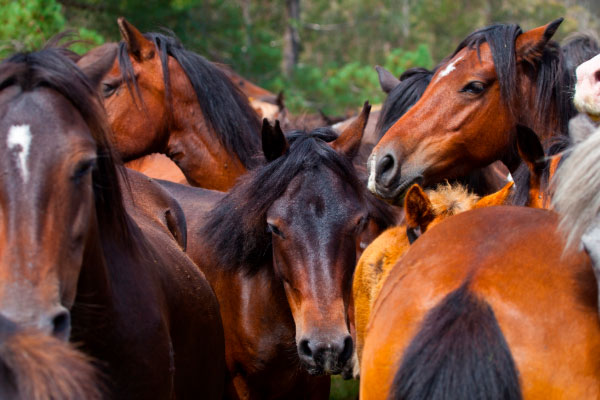
A Rapa das Bestas, an ancient ritual for discovering Galicia
A Rapa das Bestas is a centuries-old Galician tradition in which villagers round up wild horses from the mountains, cut their manes and tails by hand, treat them for parasites, and release them back to freedom. Held every first weekend of July in the village of Sabucedo (Pontevedra, Spain), it is one of Galicia’s oldest living festivals and has been officially declared a Festival of International Tourist Interest.
If there’s one thing worth talking about in Galicia during the summer, it’s festivals — and here, there’s no shortage of them. A Rapa das Bestas in Sabucedo is a celebration rooted in our most ancestral traditions, one you experience with your whole body: the smell of mountain brush and horse sweat clinging to your skin.
Every first weekend of July, a tiny village of barely 200 residents in the heart of the Tabeirós-Terra de Montes region becomes the stage for one of the oldest, most authentic, and most awe-inspiring traditions in Galicia.
At Rutas Meigas, we’ve always invited you to explore the Galician landscape — its trails, its forests, and its people. Few experiences capture the spirit of this land better than A Rapa das Bestas, a ritual where humans and wild horses meet, hand to hide, in a dance as old as Galicia itself.
What is A Rapa das Bestas?
The name “As Bestas” may ring a bell if you’ve seen The Beasts, Rodrigo Sorogoyen’s award-winning film — though here, we’re talking about horses, not the movie’s plot. A Rapa das Bestas, literally “the shearing of the beasts,” is the name given to one of the most distinctive traditions in Galician folk culture.
The ritual involves rounding up wild horses that live freely in the mountains, driving them into a circular stone enclosure called a curro, cutting their manes and tails, deworming them, treating any wounds, and marking them — before releasing them back into the wild.
This isn’t a show staged for tourists. It’s a centuries-old livestock management ritual that has evolved into one of Galicia‘s most recognizable cultural markers. The Greek geographer Strabo described, over 2,000 years ago, how the peoples of the northwestern Iberian Peninsula rounded up their wild horses with shouts and dramatic gestures. That same scene, with a few modern nuances, still plays out today.
The stars of the Rapa das Bestas are purebred Galician horses (caballo de pura raza gallega) and mixed Galician-breed horses — small, hardy, and extraordinarily resilient animals that have survived in the wild for centuries across Galicia’s hills. Their role goes far beyond folklore: by grazing on gorse, heather, and scrubland, these wild horses play a key role in wildfire prevention by keeping Galicia’s mountains clear of overgrowth. Caring for them, controlling their population, and keeping them healthy is, at its core, the real reason the rapa exists — and in an era of climate change, that role has never been more important.
A tradition celebrated across Galicia
While Sabucedo is by far the most famous, A Rapa das Bestas isn’t an isolated phenomenon. In fact, some of the oldest capitals in Santiago de Compostela Cathedral already depict a medieval aloitador (horse wrestler) grappling hand-to-hand with a horse.
Today, more than a dozen curros across the Galician countryside — mostly in the mountain ranges of southern Pontevedra — hold their own version of the rapa between spring and summer:
- Curro de Valga and Curro de Torroña, in Oia (Pontevedra) — May and June
- Curro de Mougás, also in Oia — mid-June
- Curro de Morgadáns and Curro de San Cibrán, in Gondomar, on the slopes of Mount Galiñeiro
- Curro da Capelada, in Cedeira (A Coruña)
- Curro Campo do Oso, in Mondoñedo (Lugo)
- Curro de Candaoso, in Viveiro (Lugo) — also officially declared of Tourist Interest
- Curro de Amil, in Moraña, and Curro de Monte Castelo, in Cotobade — held in July
A Rapa das Bestas reflects the communal spirit of Galicia‘s villages, respect for an animal that roams free nearly all year, and an awareness of preserving a bond between people and mountain that dates back at least to the Iron Age.
Still, none of these other curros has reached the fame, scale, or symbolic weight of Sabucedo’s.
Sabucedo: the Origin of a legend over three centuries old
The parish of San Lourenzo de Sabucedo, part of the municipality of A Estrada in the province of Pontevedra, near Santiago de Compostela, is a tiny place — barely six square kilometers — that sees its population multiply many times over during the first weekend of July, as visitors arrive from across Galicia, Spain, and around the world.
Sabucedo’s rapa has ancestral roots, and like most age-old traditions, its exact origin blurs the line between history and legend. Oral tradition tells of a plague that devastated the region centuries ago, when two sisters promised San Lourenzo, the parish’s patron saint, that they would donate two of their horses if the disease came to an end. The plague subsided, the promise was kept, and since the Church could own animals but not care for them day to day, local villagers took on the task themselves — gathering, marking, and tending to the horses once a year, while letting them roam free the rest of the time.
The earliest written records describing a rapa similar to today’s ceremony date back to 1682, making Sabucedo’s tradition one of the oldest continuously living customs in all of Galicia.
The Curro de Sabucedo: Galicia’s purest Rapa
What sets the Curro de Sabucedo apart from every other is how the confrontation between human and horse unfolds. No ropes, lassos, or sticks are used here. Instead, the aloitadores — young men, and increasingly young women, from Sabucedo — face the animals using only their bare hands and a knowledge of horses passed down through generations. It’s likely the only curro in Galicia where the struggle happens entirely hand-to-hand, body-to-body.
The current enclosure was built in the 18th century, adjoining the parish church itself. Its stone walls and semicircular stands, arranged like a small amphitheater, let hundreds of spectators watch the action up close without interfering — a piece of vernacular architecture that has served the same purpose for three centuries.
A Baixa: the search in the mountains
It all begins before dawn, when the people of Sabucedo climb Montouto mountain to locate the horse herds that have spent the year grazing freely. Guided by their deep knowledge of the terrain and the animals’ behavior, they slowly encircle the herds and, with patience and skill, drive them down toward the village.
O Curro: the hand-to-hand struggle
Once the wild horses are inside the enclosure, the festival reaches its climax. The aloitadores and aloitadoras work in small teams of three. Two of them handle the horse’s head, working to hold and subdue the animal, while the third controls the tail to avoid kicks. It’s an intense, full-body struggle — equal parts strength and technique — that ends with the cutting of the horse’s mane and tail, deworming, and a health check. The youngest foals are separated first to keep them safe during the wrestling.
Os Aloitadores & as Aloitadoras: guardians of a living tradition
Being an aloitador in Sabucedo is a role passed down through generations — one you grow up watching in a father, an uncle, or a neighbor, and one that demands an intimate understanding of horse behavior that only comes with years of experience. Each edition of the rapa pays tribute to these men and women, the true guardians of a tradition they carry, quite literally, on their shoulders, generation after generation.
A Rapa das Bestas de Sabucedo: Festival Program
The celebration has been officially declared a Festival of International Tourist Interest.
The program unfolds over four days:
- Day 1: A tribute gala honoring the aloitadores and aloitadoras
- Day 2: Mass in honor of San Lourenzo, followed by A Baixa — the trip up the mountain to round up the horses
- Saturday: The horses arrive in Sabucedo, and the first major curro session takes place in the afternoon
- Sunday: The experience repeats, typically with a midday session and another at dusk
- Monday: The festival closes with the final curro session and the horses’ return to the mountains
Between curro sessions, the whole village turns into one big street party — as only Galicia can do it — with parades, traditional bagpipe (gaita) music, concerts as part of the Rapasons festival, and food and craft stalls lining the streets.
Each edition brings together more than 600 wild horses across roughly 14 herds — a display of strength and community organization that’s as hard to match as it is to forget. A ticket is required to watch the curro sessions from the stands, so it’s worth planning ahead if you want to experience it up close.
Discover Galicia with Rutas Meigas
Galicia is full of places waiting to be discovered — more than you’d ever imagine.
Tabeirós-Terra de Montes is a land of forests, rivers, and villages, perfect for unhurried hiking and exploration, and it sits just a short distance from Santiago de Compostela.
Pairing the end of your Camino de Santiago with a visit to Sabucedo, exploring Padrón — one of the towns most closely tied to the Jacobean tradition — or hiking a route through the Serra do Barbanza, is the best way to understand why this land remains so deeply connected to its traditions.
Rutas Meigas | Specialists in Camino de Santiago and hiking in Galicia | rutasmeigas.com
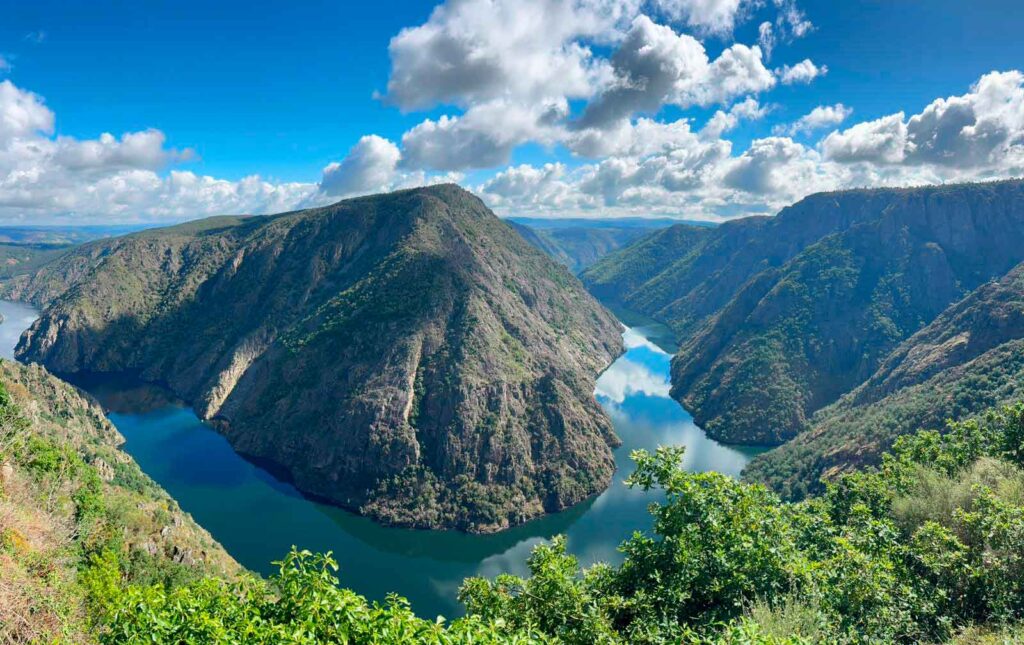
Hiking the Ribeira Sacra: O Camiño do Monxe
Some trails don’t appear in mainstream travel guides. They don’t seek crowds or easy fame. Instead, they wait in quiet patience for the right traveller to find them. O Camiño do Monxe — the Monk’s Way — is exactly that kind of trail. A circular 144-kilometre hiking route through the heart of Galicia’s Ribeira Sacra, it stands as one of the most authentic and least-explored long-distance walking experiences in the whole of Spain.
At Rutas Meigas, we have spent years introducing travellers to Galicia beyond its most-walked paths. When we hand our guests the keys to O Camiño do Monxe, something invariably happens: they come back changed. Not metaphorically. This route carries an ancient pulse, a density of landscape and history, that leaves a mark on everyone who walks it.
What is O Camiño do Monxe?
O Camiño do Monxe was created by passionate local enthusiasts deeply committed to sharing the authentic soul of their land. The trail follows a network of ancient paths that predate the monasteries themselves, the Roman conquest and even the Iron Age hillforts that still crown the slopes of this extraordinary region. These are millennium-old tracks etched into the earth, connecting villages, farmland and sacred sites across a landscape that is profoundly, breathtakingly rural.
The route immerses hikers in the most genuine face of the Ribeira Sacra: dense oak and chestnut forests, steep riverbanks above deep river gorges, golden-stone Romanesque monasteries, medieval castles perched on vertiginous ridges and living villages where time seems to have stood still. A 144-kilometre journey divided into 7 stages of between 19 and 22 kilometres each, with moderate difficulty that makes it accessible to experienced hikers in good physical condition.
The route is circular, starting and finishing in Castro Caldelas, one of the most charming towns in the region. No need to coordinate two different arrival and departure points — the traveller returns to the same place they started from, completing a perfect circle both on the map and in the spirit.
Hiking the Ribeira Sacra: far more than a wine wegion
For many visitors, the Ribeira Sacra is synonymous with wine. And understandably so: the breathtaking terraced vineyards cascading vertically down to the canyons of the Sil and Miño rivers represent one of the most spectacular wine landscapes in all of Europe. But to reduce this comarca to its Mencía or Godello production would be an unforgivable oversight.
The Ribeira Sacra is, above all, sacred — as its very name declares. From the earliest centuries of Christianity, hermits and monks chose these steep valleys and impenetrable forests as places to withdraw from the world and build their spiritual communities. The result is an extraordinary concentration of Romanesque heritage without parallel anywhere in Spain: dozens of monasteries, churches, chapels and hermitages scattered across a geography that seems purpose-built for contemplation and retreat.
But the history of this land runs even deeper. Before the medieval monks came Rome. Before Rome, the Celtic hillfort peoples. And before them, a humanity that left its marks in stone and earth in ways we still do not fully understand. O Camiño do Monxe passes through all those layers, superimposing eras and cultures with every step.
The 7 Stages: a journey through time
Stage 1: Castro Caldelas – Fábrica da Luz
The first stage sets off from Castro Caldelas, dominated by its imposing medieval castle, and enters the Galician mountain landscape along rural paths through ancient chestnut trees. The highlight of this opening day is the passage through the ruins of the Monastery of San Paio de Abeleda, a medieval monastic complex steeped in history and wrapped in the deep silence of the Ribeira Sacra. The stage ends at the spectacular Pasarelas del Río Mao at the Fábrica da Luz, where wild nature and 20th-century industrial heritage create a combination of barely describable beauty.
Stage 2: Fábrica da Luz – Parada de Sil
The second stage unfolds alongside the great protagonist of the Ribeira Sacra: the Sil Canyon. The trail hugs the river for several kilometres, offering perspectives of the gorge that would justify the entire trip on their own. The peak moment arrives at the Balcones de Madrid viewpoints, among the most breathtaking lookout points in all of Galicia, where the curves of the Sil disappearing between forest-covered mountains create an image impossible to forget. The stage also passes through the landscape surrounding the Monastery of Santa Cristina de Ribas de Sil, currently under restoration but still a place of powerful spiritual presence.
Stage 3: Parada de Sil – Santo Estevo
Arguably the most panoramic of all seven stages. The succession of viewpoints punctuating this stretch — Cotarro, Cabezoá, A Columna, Vilouxe, Pé do Home — turns this day’s walk into a continuous parade of privileged views over the Sil canyons. The stage finale at the Monastery of Santo Estevo is one of the most emotionally charged moments of the entire route: arriving at this magnificent Romanesque complex, today converted into a Parador de Turismo, after hours of walking through forests and stopping at miradores, produces a feeling that is genuinely unique.
Stage 4: Santo Estevo – Esgos
The fourth stage begins with a significant ascent from the monastery following the Natural Trail, which allows walkers to contemplate the Santo Estevo complex from above. The trail leads to the Cabeza de Meda wind farm and descends toward Esgos through open moorland landscapes. The undeniable highlight is the visit to the Monastery of San Pedro de Rocas, the oldest in the Ribeira Sacra and in all of Galicia, dating from the 6th century and partially excavated from the living rock. An archaeological and historical treasure that rewards all the time one can give it.
Stage 5: Esgos – Maceda
This stage connects the Ribeira Sacra with the high interior lands of Galicia, travelling along the Ribeira Sacra Natural Trail and arriving at the Monastery of Santa María de San Pedro de Espadanedo, where hikers can collect one of the most distinctive stamps on the entire route — wax-sealed in the medieval style. The day ends at the Castle of Maceda, a medieval fortress that commands the surrounding countryside with patrician authority.
Stage 6: Maceda – Montederramo
The penultimate stage leads the traveller to the spiritual heart of the entire route: the Monastery of Santa María de Montederramo, considered the most important monastery in the Ribeira Sacra. The trail crosses open mountain landscapes with spectacular panoramic views and passes through villages where rural Galician life continues with full authenticity. A demanding stage in certain sections, but extraordinarily rich in both landscape and emotional resonance.
Stage 7: Montederramo – Castro Caldelas
The final stage closes the circle, returning to Castro Caldelas. The path leaves from the Monastery of Montederramo and traverses forest and moorland landscapes through Romanesque chapels and hermitages, passing the Chapel of As Neves and culminating in the Monastery of San Juan de Camba before returning to the starting point. A finale that invites deep reflection on the complete journey — the landscapes, the monasteries and the silences the traveller now carries within them.
Why O Camiño do Monxe is unlike any other trail
At a time when many hiking routes have become backpacker motorways, O Camiño do Monxe represents something radically different. Here you won’t find queues at hostels, mass selfies at scenic spots or the sense of doing something already done by millions before you. This trail is still genuinely wild, in the very best sense of the word.
The signage, in certain sections, can be sparse or ambiguous, making a downloaded GPS track on your phone or dedicated device almost indispensable. But far from being a weakness, this is part of the appeal: O Camiño do Monxe demands attention, presence and real engagement with the terrain. It is not a trail to walk on autopilot. It is a trail that asks you to be fully awake.
The landscapes offer a variety and beauty that few routes in Spain can match: from the deepest river gorges on the Iberian Peninsula to the most silent mountain forests, through millennia-old vineyards, eternal-looking stone villages and Romanesque monuments that have been gazing at the Galician sky for centuries. Each stage has its own personality and offers radically different experiences.
Hiking the Ribeira Sacra with Rutas Meigas: your Journey, without the worry
Organising a 9-day, 144-kilometre journey through unfamiliar territory can be complex. That’s why at Rutas Meigas we offer a complete package so the traveller can focus exclusively on walking, discovering and enjoying.
O Camiño do Monxe with Rutas Meigas starts from €890 per person (price valid September to June; please contact us for July and August pricing). The package includes 9 days and 8 nights in private rooms with private bathrooms, bed and breakfast accommodation, luggage transfer between stages so you never have to carry a full pack, and the necessary transfers as marked in the itinerary. Everything organised so that the only effort required is the walk itself.
- 9 days / 8 nights in private room with private bathroom
- Breakfast included every morning
- Luggage transfer between stages
- Transfers as per itinerary
- Personalised attention and Rutas Meigas support throughout
Rutas Meigas is a travel agency specialised in hiking and the Camino de Santiago, based in Galicia. Our deep knowledge of the territory, combined with our network of carefully selected accommodations, allows us to offer a quality experience that goes far beyond simple logistics.
Who Is This Trail For?
O Camiño do Monxe is ideal for experienced multi-day hikers seeking something authentic, far from mass tourism. Moderate difficulty means it is accessible to people with reasonable fitness and hiking experience, but not to complete beginners. Stages of between 19 and 22 kilometres require stamina and solid footwear.
It is also a perfect route for lovers of historical heritage and Romanesque architecture, for those who find Galician nature and its unique forests to be something more than mere backdrop, and for travellers who value silence, authenticity and direct contact with local communities that keep their traditions alive. If you seek a trail where every step carries meaning and where the landscape is not merely beautiful but deeply evocative, O Camiño do Monxe is your route.
How to plan your Hiking the Ribeira Sacra with Rutas Meigas
If O Camiño do Monxe has sparked your interest, the next step is simple: contact Rutas Meigas team for a personalised proposal tailored to your dates and needs. You can reach us through our website, by phone or by email. Our team will advise you on the best season for the route, the equipment you’ll need, arrival logistics and all the practical details to make your Ribeira Sacra adventure truly perfect.
The ideal seasons for O Camiño do Monxe are spring and autumn, when the forests of the Ribeira Sacra display their most spectacular colours and walking temperatures are just right. Summer is also possible, though inland temperatures can be higher. Rain — Galicia’s inseparable companion — can appear at any time of year, so a good waterproof layer is always welcome.
Ready to walk O Camiño do Monxe? Rutas Meigas takes care of everything. Write to info@rutasmeigas.com or call us at +34 881 019 941.
Rutas Meigas | Specialists in Camino de Santiago and hiking in Galicia | rutasmeigas.com
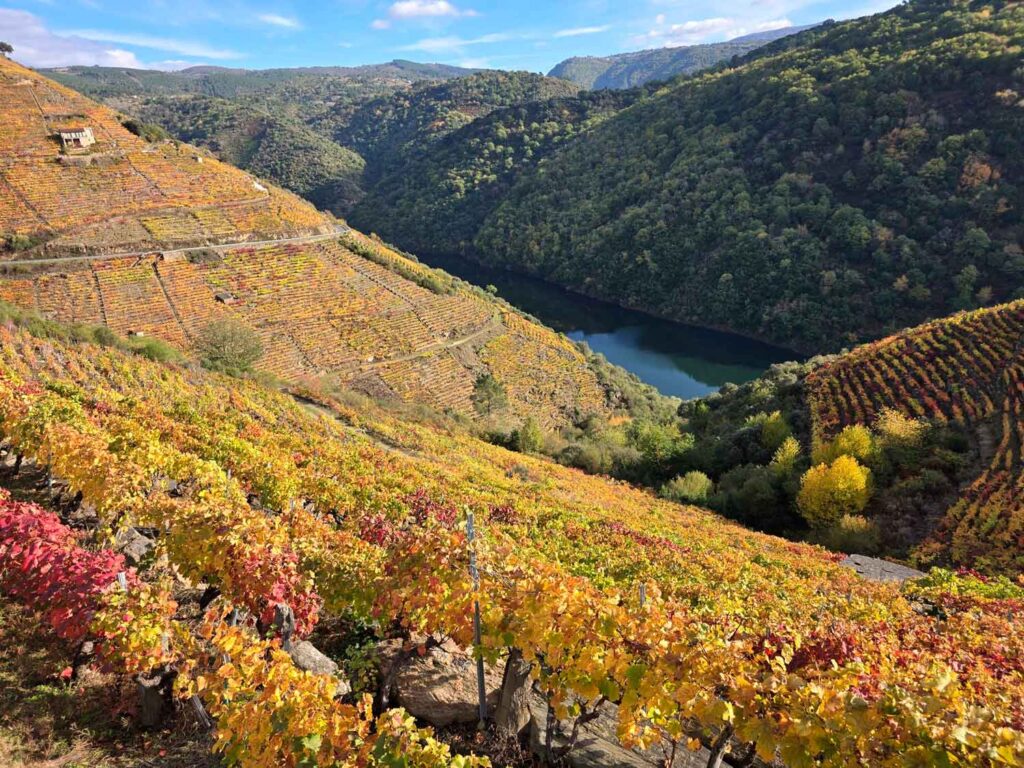
Wine, history and landscape: Wine Tourism in Galicia’s Ribeira Sacra
Some wine regions are born of ease: flat land, simple mechanisation, economies of scale. And then there is the Ribeira Sacra. Here, wine was born not of convenience but of necessity, of faith, and of an almost supernatural stubbornness in coaxing fruit from slopes that the rest of the world would have written off as impossible. A territory where every bottle carries the imprint of a civilisation that chose to plant vines where no logic justified it — and where the result is a wine that tastes, literally, of mountain, slate, river and centuries.
At Rutas Meigas we have been in love with this landscape and its people since 1998. And since that very same year we have shared our path with Adega Algueira, a family winery that is exactly the same age as us, and that represents, better than any other, the spirit of this land: deep, authentic, heroic.
The Ribeira Sacra and wine: a two-thousand-year story
The winemaking history of the Ribeira Sacra stretches back at least to Roman times. When Rome’s legions advanced into the northwestern corner of the Iberian Peninsula in the first century BC, they found in the valleys of the Sil and Miño an extraordinary landscape for viticulture: steep south-facing slopes that captured maximum solar radiation, slate soils with perfect drainage, and the thermoregulating influence of the rivers that created a unique microclimate, sheltered from Atlantic excesses and continental frosts.
The Romans wasted no time. They began terracing the slopes with dry-stone walls, creating the stepped bancales that are today the most recognisable visual symbol of the Ribeira Sacra. But it was the medieval monks who turned viticulture into the economic and spiritual backbone of the entire region. From the 6th and 7th centuries onwards, the hermits who settled along these riverbanks found in wine not only an essential foodstuff but an indispensable liturgical element. The great monasteries — Santo Estevo, Santa Cristina, San Paio de Abeleda, Montederramo — became the first large organised wine producers, developing cultivation and winemaking techniques that laid the foundations for what we now call heroic viticulture.
The term “heroic” is neither rhetorical nor marketing spin. The International Organisation of Vine and Wine (OIV) defines heroic viticulture as farming practised under extreme conditions: slopes exceeding 30%, altitudes above 500 metres, narrow terraces that prevent mechanisation, or a combination of these factors. In the Ribeira Sacra, virtually the entire vineyard area meets one or more of these criteria. Slopes that in some places exceed 70% mean that every harvest is a physical and logistical feat that only passion and generational knowledge can accomplish.
During the Middle Ages, wine production in the Ribeira Sacra reached levels that would surprise us today. Historical records describe a region intensively cultivated, with vineyards covering slopes that are now largely abandoned or reclaimed by forest. Decline came with the 19th-century ecclesiastical confiscations that dismantled the monastic system sustaining viticulture for centuries, and deepened with the rural exodus of the 20th century, when thousands abandoned these valleys for work in cities and abroad.
Recovery arrived in the 1980s and 90s, driven by a group of vintners with vision, determination and a profound love for their land. The granting of Denominación de Origen status to Ribeira Sacra in 1996 was official recognition of what those pioneers already knew: that these wines, made with the indigenous Mencía variety and with other nearly forgotten varieties such as Merenzao, Brancellao, Godello and Treixadura, possessed a personality and quality that the national and international market had yet to discover. What followed would become an unprecedented success story in Spanish wine history.
The Wine Landscape: why the Ribeira Sacra is unique in the world
To understand Ribeira Sacra wine, one must first understand its landscape. The Sil and Miño rivers have carved their way through the Galician mountains over millions of years, creating canyons up to 500 metres deep that are, without question, one of the most impressive geological spectacles on the entire Iberian Peninsula. The canyon slopes, covered in dark slate that absorbs heat during the day and releases it slowly at night, create an ideal thermal environment for grape ripening.
Slate is, in many ways, the soul of Ribeira Sacra wine. This type of soil, poor in nutrients but rich in minerals, forces the vines to drive their roots deep into the rock in search of water and sustenance. The result is a vine that struggles, that fights, and in that struggle concentrates in its clusters an aromatic intensity and a mineral complexity that is virtually impossible to achieve in more generous soils. When wine lovers speak of the “minerality” of a Ribeira Sacra Mencía, they are speaking, literally, of slate: that taste of wet stone, of flint, of geological depth that no other Iberian terroir reproduces in quite the same way.
All of this is complemented by the Ribeira Sacra Denominación de Origen, which encompasses five differentiated sub-zones with their own characteristics: Amandi, Chantada, Quiroga-Bibei, Ribeiras do Miño and Ribeiras do Sil. Each produces wines with different nuances depending on altitude, slope orientation, soil composition and local microclimate. This internal diversity is another of the DO’s great assets, allowing a wine enthusiast to spend years exploring its different expressions without exhausting the surprises.
Adega Algueira: when wine is a vocation and a legacy
In 1998 — the same year Rutas Meigas opened its doors to the world — Fernando González planted the first vines at Doade, on the banks of the Sil, in what would become Adega Algueira. But the real story begins earlier: in 1979, when Fernando discovered an old vineyard hidden among stone-walled terraces at Carballo Cobo, a plot that captivated him from the very first moment and would become the spiritual and physical origin of the entire winery.
The story of Algueira is the story of a recovery. When Fernando began working the Sil vineyards, he found abandoned plots, crumbled walls, old vines barely surviving among scrub. What others saw as a landscape in decline, he saw as a heritage to be rescued. Every vine recovered, every terrace wall rebuilt, every nearly-forgotten variety that bore fruit again was a small victory against oblivion and abandonment.
Algueira’s philosophy rests on three pillars that perfectly summarise the winery’s spirit. The first is recovery and protection: rescuing historic vineyards and conserving the slate soils and century-old terraces that form part of the living memory of the Ribeira Sacra. The second is celebrating diversity: beyond the ever-present Mencía, Algueira works with Merenzao, Brancellao, Sousón, Caíño, Godello, Treixadura and other indigenous varieties that enrich the vinous identity of the region. The third is innovating from tradition: researching, experimenting and creating wines that surprise, always faithful to the terroir and respectful of nature.
The result of this philosophy is a range of wines that are, in themselves, a map of the Ribeira Sacra. Each Algueira label responds to a question, an exploration, a specific vineyard or a rediscovered variety, a collection that is at once a catalogue of nearly-forgotten varieties and a declaration of love for this land.
Wine Tourism in the Ribeira Sacra: living wine from the Inside
The Ribeira Sacra is, increasingly, a first-class wine tourism destination. Not only because its wines are exceptional, but because visiting this region uniquely combines oenological pleasure with immersion in a landscape that is, in itself, a work of art. The heroic vineyards hanging above the Sil canyons are not just a picturesque backdrop: they are the indispensable context for understanding why the wine produced here tastes the way it does.
Combining Wine Tourism and Hiking: the Rutas Meigas approach
At Rutas Meigas we believe that wine and hiking are two complementary and deeply Galician ways of relating to a territory. Walking the Ribeira Sacra — through routes like O Camiño do Monxe or any of the comarca’s other trails — and stopping to discover its wineries, its wines and its people, is the most complete way of understanding this place.
The partnership between Rutas Meigas and Adega Algueira has been built over more than 25 years with the same philosophy: offering travellers authentic experiences that connect them with the best of Galicia. When we organise routes through the Ribeira Sacra, a visit to Algueira is one of those stops we consider essential — not as a tourist add-on but as a central experience, capable of adding a layer of understanding and enjoyment that transcends the simple tasting of a wine.
- Hiking routes through the Ribeira Sacra with stops at selected wineries
- Guided visits to Adega Algueira with tasting included
- Boat trip through the Sil Canyon
- Traditional lunch
- Combination with O Camiño do Monxe or other routes in the region
- Private room accommodation with en-suite bathroom and luggage transfer
Everything organised by Rutas Meigas so that the traveller need not worry about a single logistical detail and can focus exclusively on what matters: discovering the Ribeira Sacra from within.
The Ribeira Sacra on the International Wine Tourism Map
In recent years, the Ribeira Sacra has leapt from being a relatively unknown region outside Spain to being regularly cited by the most influential wine guides and publications in the world. Algueira’s wines, like those of other benchmark wineries in the DO, have appeared on the wine lists of Michelin-starred restaurants across Europe and the Americas, and Ribeira Sacra Mencía has become a standard reference in discussions about the most interesting Spanish reds of the present day.
This international recognition has driven a quality wine tourism that attracts enthusiasts from across the world. Visitors from Germany, the United Kingdom, the United States, Japan and the Nordic countries travel specifically to the Ribeira Sacra to explore its vineyards, visit its wineries and walk its trails. The region uniquely combines what many wine tourism destinations offer separately: great wines, extraordinary landscapes, millennia of history, excellent gastronomy and a cultural authenticity that mass tourism has not yet eroded.
Fancy discovering the Ribeira Sacra among vineyards and canyons? Rutas Meigas makes it possible. Write to us at info@rutasmeigas.com or call +34 881 019 941.
Because Ribeira Sacra wine cannot be explained: it must be walked, navigated, smelled and drunk. And then, inevitably, missed. Because as they say in Galicia: witches don’t exist — but in the Ribeira Sacra, if they do, they’re here.
Rutas Meigas | Specialists in Camino de Santiago and hiking in Galicia | rutasmeigas.com
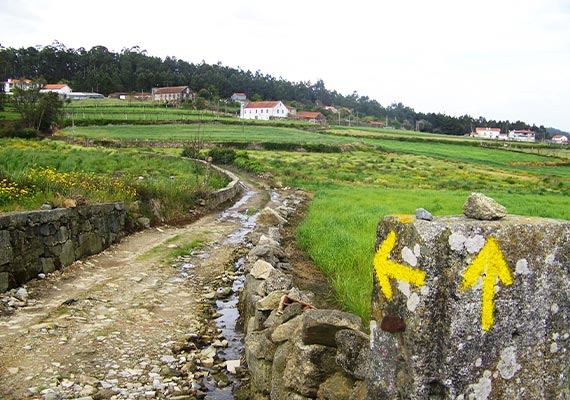
The yellow arrow on the Camino de Santiago and Elías Valiña
If you think reaching Santiago de Compostela on foot today can sometimes be challenging — even with Google Maps, which honestly will not help much on certain stretches — imagine what it was like in the Middle Ages, when pilgrims had no maps at all.
Today, along many sections of the Camino de Santiago, pilgrims simply follow the famous yellow arrows. Every time you spot one, you know you are on the right path, that the Saint James Way continues in that direction.
But those yellow arrows are actually quite recent. And we owe them to Elías Valiña Sampedro, the parish priest of O Cebreiro who, armed with cans of yellow paint and a tiny Citroën 2CV, changed the history of the Camino de Santiago forever.
The priest of the first Galician village on the Camino Francés
Elías Valiña was born in 1929 in Mundín, a small hamlet near Sarria, in the province of Lugo. He was ordained as a priest in 1957 and assigned to the parish of Santa María la Real de O Cebreiro, the iconic mountain village of stone pallozas and perpetual mist where the Camino Francés enters Galicia. There he would live, work, and eventually die. He spent thirty-two years serving the same parish, with a dedication that went far beyond ordinary religious duties.
Valiña was a highly educated man. He earned a degree in Canon Law from the Pontifical University of Comillas and later completed his doctorate at the University of Salamanca. As early as 1961–62, he wrote his doctoral thesis titled “The Camino de Santiago: A Historical-Legal Study,” becoming one of the first scholars to approach the pilgrimage route with true academic rigor.
At that time, the Camino de Santiago was little more than a fading memory. Many stretches had disappeared beneath vegetation, and the few pilgrims who dared to attempt the route frequently got lost. The medieval pilgrimage tradition seemed destined to vanish.
The story of the yellow arrows on the Camino de Santiago
In 1984, Elías Valiña undertook the task that would immortalize him: the complete waymarking of the Camino Francés from Roncesvalles to Santiago de Compostela.
He climbed into his small Citroën 2CV, loaded it with cans of paint, and drove hundreds of kilometers along the pilgrimage route, stopping at every crossroads, every fork, and every place where a pilgrim might hesitate.
And there, he painted a very simple symbol to indicate the direction forward: arrows.
The color itself, like many great ideas throughout history, comes with its own legend. Some say the priest bought leftover yellow paint from roadwork projects at a very low price and simply used what was available. His nephew and close collaborator, José Manuel López Valiña, offers a less accidental explanation: according to him, the priest had observed in France that yellow was commonly used to mark mountain hiking trails and consciously chose it because of its high visibility and durability.
Whether coincidence or vision, the result was the same: yellow became the universal language of the Camino de Santiago.
And, of course, there is also the anecdote that history has transformed into legend. According to the story, while painting yellow arrows in the Pyrenees, Elías Valiña was stopped by the Guardia Civil, suspicious of the mysterious markings appearing throughout the mountains.
“What are you doing?” they asked him.
The priest’s answer was as dry as it was unexpected:
“I am preparing an invasion.”
Only instead of soldiers, the invaders would be pilgrims.
Much more than a yellow arrow pointing toward Compostela
The yellow arrow is Elías Valiña’s most visible legacy, but his work went far beyond waymarking.
He promoted the restoration of the historic village of O Cebreiro, a project that culminated in 1971 with the inauguration of its Ethnographic Museum. He recovered lost stretches of the Camino in Galicia, cleared overgrown paths, created maps, and wrote pilgrimage guides.
Between 1985 and 1987, he personally edited and published the Boletín del Camino de Santiago, a modest but essential newsletter for the emerging network of pilgrims and Camino associations.
He was also a tireless hospitalero. He reopened the pilgrims’ hostel in O Cebreiro and managed it together with his family, welcoming the few pilgrims who ventured along the route during those years.
In 1985, during the First Jacobean Gathering held in Santiago de Compostela, he was unanimously appointed Commissioner of the Camino de Santiago. Two years later, he organized the International Congress of the Camino de Santiago in Jaca, where the foundations were laid for the Camino’s recognition as a European Cultural Itinerary — a title officially granted by the Council of Europe later that same year, 1987.
Always on the Camino
Elías Valiña died on December 11, 1989, at the age of 60, after suffering from cancer.
The first Holy Year in which the Camino de Santiago would once again overflow with pilgrims — the famous Xacobeo 1993 — arrived four years after his death. He never lived to see the full impact of his work.
It is said that before he died, he made one final request to his family: to ensure that the yellow arrow would never disappear from the Camino.
His nephew José Manuel, together with British writer and historian Laurie Dennett, continued the mapping project that the priest had left unfinished.
Today, Elías Valiña rests in the basilica of Santa María la Real de O Cebreiro. On the stone marking his grave, only three words are engraved in Galician:
“Sempre no Camiño” — “Always on the Camino.”
The yellow arrow followed by hundreds of thousands of Pilgrims
Every time you look up and see a yellow arrow painted on a wall, a tree trunk, or the arch of an old bridge, you are following the spirit of that mountain priest who, at a time when the Camino de Santiago was little more than a forgotten trail, decided to bring it back to life.
On our Camino de Santiago routes, we stop in O Cebreiro not only to admire its ancient pallozas — sometimes covered in snow — or the mist rising from the valleys. That place also tells the story of the priest who, with nothing more than cans of yellow paint, marked the way forward for generations of pilgrims.
Because of his enormous legacy, a documentary was made about his life: “Elías Valiña, the Inventor of the Yellow Arrows.” On February 2nd, 2025, the first-ever Elías Valiña Sampedro Day was celebrated, coinciding with the 96th anniversary of his birth, with commemorative events in Sarria and the unveiling of a memorial plaque at his birthplace in Mundín.
Today, Elías Valiña is no longer simply part of the Camino de Santiago. He is part of its history.
Buen Camino!
Broom Branches on the Camino de Santiago. Why Galicia Turns Yellow in Spring
You’ve been walking for several days toward Compostela, enjoying the endless green landscapes of Galicia, its tiny villages with granite houses, the scent of eucalyptus and damp earth. Suddenly, something catches your eye: a bunch of yellow-flowered branches hanging on the door of a house. Then you spot another one on the bumper of a car. Another tied to the rearview mirror of a van. If you are walking the Camino de Santiago along the coast, you may even see them on fishing boats. Naturally, you start wondering why.
Well, here’s the answer.
Welcome to one of Galicia’s oldest and most vibrant traditions: Os Maios.
Xesta, the flower of protection
What you are seeing on doors and vehicles is called xesta, known in English as Scotch broom or common broom (Cytisus scoparius). It is a shrub commonly found throughout the hills and trails of Galicia, and between April and July it bursts into intense yellow bloom, painting the landscape gold.
During May, when thousands of pilgrims walk the Camino de Santiago — also known internationally as the Saint James Way — xesta is in full bloom, making it impossible to miss.
But this is Galicia, a land of ancient magic and superstition, so xesta is not just decorative. It is believed to protect.
According to Galician tradition, placing branches of xesta at the entrance of a house, on a fishing boat, or in a car before dawn on May 1st keeps negative forces away as the new month begins.
As elders from the Rías Baixas say, it is done “so that May cannot enter, nor any evil spell take hold.” In other words, to keep bad luck, the evil eye, and dark spirits from finding their way into your life during the month ahead.
What are “Os Maios”?
The Festa dos Maios is one of Galicia’s oldest celebrations. Its origins date back to the pre-Roman civilizations of northwestern Iberia, with possible links to the Celtic festival of Beltane — celebrated on the night of April 30th to May 1st and marking the beginning of the pastoral summer — as well as to the Roman worship of Maia, goddess of fertility and spring. Some ethnographers have even connected the conical shapes of the festival structures with ancient Celtic ritual mounds or burial monuments.
What Galicians call maios are elaborate vegetal structures built from wooden frames covered with moss, fennel, xesta, and wildflowers, usually shaped like cones or pyramids.
At the top, there is almost always a cross, because in Galicia religion and superstition walk hand in hand.
These creations parade through towns and villages during the first days of May, accompanied by traditional songs known as coplas, often humorous or satirical, delighting locals of all ages.
The materials used to build Os Maios must always be natural and, according to the oldest traditions, ideally “stolen,” as the ritual once required.
There are two main types of maios: the traditional cone- or pyramid-shaped structures — especially famous in Ourense, where some can exceed five meters in height — and the more artistic versions, which recreate granaries, stone crosses, bridges, animals, boats, or even human figures with remarkable creativity.
In coastal towns such as Marín, many maios naturally take the shape of fishing boats.
A Galician tradition that has survived everything
What makes Os Maios truly extraordinary is not only their age, but their ability to survive through centuries of change.
The tradition endured Romanization, medieval Christianization, social transformations, and modernity itself. Yet every spring, Galicia still dresses in yellow.
In the past, farmers decorated cattle horns and farming tools with xesta branches. Today the gesture remains essentially the same: invoking protection, celebrating nature’s rebirth, and finally shutting the door on winter.
In the city of Ourense, the Festa dos Maios was officially declared a Festival of National Tourist Interest in 2001. In Pontevedra, Vilagarcía de Arousa, Redondela, Marín, Portonovo, and dozens of villages across Galicia, maios competitions and traditional songs continue to bring entire communities together to celebrate the arrival of spring.
The Camino de Santiago and Os Maios: spirituality and superstition
For pilgrims walking the Camino de Santiago in spring, encountering Os Maios is one of those unexpected experiences that makes the Saint James Way even more unforgettable.
Galicia is a land where the sacred, superstition, and everyday life blend together naturally; where pagan rituals and Christian traditions coexist without contradiction; where magic is simply part of life. As Galicians like to say: “haberlas, haylas” — witches may or may not be seen, but they definitely exist.
So, if you come across those yellow flowering branches hanging from a doorway, now you know that this humble xesta has been protecting the people behind that threshold for thousands of years.
And perhaps it is not such a bad idea to tie a small branch to your pilgrim backpack, just in case you would like a little extra protection for the rest of your Camino de Santiago journey.
Buen Camino!!!
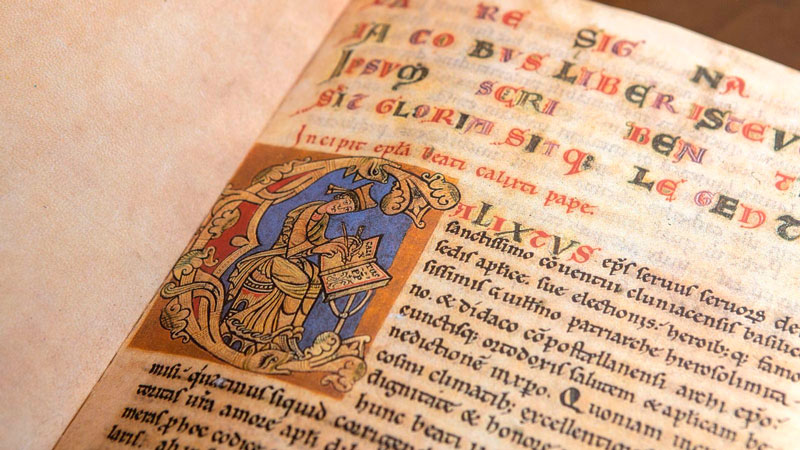
Codex Calixtinus, first guide for the Camino de Santiago
Long before printed maps, travel guidebooks, or mobile apps existed, there was already a book that taught pilgrims how to reach their destination, which routes to follow, what dangers to avoid, and what wonders they would encounter along the way.
That book was written in the Middle Ages, and its mission was clear: to guide devoted travelers to Santiago de Compostela Cathedral along the Camino de Santiago.
Today, the Codex Calixtinus is considered not only the most famous manuscript connected to the Camino de Santiago but also the first travel guide in European history. It is a monumental work that blends faith, literature, music, medieval epic storytelling, religious propaganda, and practical advice for pilgrims.
Written in Latin during the 12th century, the manuscript is preserved in the archive of Santiago de Compostela Cathedral, where it is protected under strict security measures.
A book created to make Santiago a spiritual center of Europe
The full title of the work is Liber Sancti Iacobi (Book of Saint James), although it became widely known as the Codex Calixtinus due to its false attribution to Pope Callixtus II.
In reality, its author—or authors—remain unknown. However, scholars believe it likely originated in France and was closely connected to the influential Order of Cluny.
The project was promoted by Diego Gelmírez, the powerful archbishop who played a decisive role in establishing the international prestige of Santiago de Compostela during the Middle Ages.
His goal was ambitious: to consolidate Santiago as the second great center of Christianity after Rome and to provide religious, cultural, and political legitimacy to the growing pilgrimage along the Camino de Santiago.
The Codex was not written all at once. Its compilation likely took more than forty years, from the 1120s to the 1170s, gradually expanding until reaching its final form with liturgical texts, stories, and even a musical appendix containing some of the earliest examples of Western polyphony.
Five books that built the world of the Camino de Santiago
The Codex Calixtinus is organized into five books, each designed with a specific purpose within the broader project of promoting devotion to Saint James the Greater and strengthening the pilgrimage tradition.
Book I: liturgy and spirituality
This is the longest section of the manuscript. It contains masses, sermons, hymns, blessings, and liturgical texts dedicated to Saint James.
One of the most notable texts is the famous sermon Veneranda Dies, which explains the deeper meaning of medieval pilgrimage: walking as a spiritual, penitential, and communal journey.
This section shows that the Camino de Santiago was never just a physical journey—it was a theological experience.
Book II: the miracles of Saint James
The second book gathers twenty-two miracles attributed to Saint James, reported from different regions of Europe.
Many of these stories are directly connected to the Camino de Santiago and the dangers pilgrims faced during the Middle Ages, including:
- Injustice
- Illness
- Shipwrecks
- Imprisonment
These accounts reinforced faith in the Apostle’s protection and encouraged believers to undertake the long and risky pilgrimage under his spiritual protection.
Book III: the arrival of Saint James’s body in Galicia
This section recounts the famous Translatio, the story of how the body of Saint James was transported from Jerusalem to Galicia after his martyrdom.
The narrative combines biblical elements, oral traditions, and medieval symbolism. Its purpose was to justify the historical presence of the Apostle’s tomb in Santiago de Compostela and reinforce the legitimacy of the pilgrimage destination.
Book IV: Charlemagne and the liberation of the Camino
The fourth book moves into the realm of epic storytelling.
It narrates the legendary adventures of Charlemagne and his knight Roland, who supposedly fought Muslim forces to liberate the Camino de Santiago.
This narrative, known as the Pseudo-Turpin Chronicle, is historically inaccurate but became extremely popular across medieval Europe, circulating in hundreds of copies.
Its goal was clear: to link the legendary figure of Charlemagne with the spiritual importance of Santiago.
Book V: the first travel guide in Europe
The fifth book is the most famous section of the Codex Calixtinus and the reason it is widely considered Europe’s first travel guide.
It describes in remarkable detail the French pilgrimage routes and the Camino Francés in Spain, including information about:
- Stages of the journey
- Cities and villages along the route
- Sanctuaries and relics
- Local customs
- Typical foods
- Potential dangers
- Character of local populations
- Descriptions of the Romanesque Santiago Cathedral
The guide is generally attributed to the French cleric Aymeric Picaud, who wrote from the perspective of personal pilgrimage experience.
Surprisingly modern in tone, the text combines practical travel advice with cultural observations, making it an invaluable resource for understanding the medieval Camino de Santiago.
This section has also played a key role in the modern revival of the Camino.
Music for Saint James: the first european polyphony
The Codex Calixtinus also includes a musical appendix with 21 compositions, representing some of the earliest examples of Western polyphonic music.
Among them is the famous Dum pater familias, considered the oldest preserved pilgrimage song.
This reveals that Santiago de Compostela was not only a religious center but also an important cultural and musical hub, connected to major artistic movements across medieval Europe.
Through the diffusion of the Codex Calixtinus, the Camino de Santiago became a truly continental pilgrimage route, attracting travelers from all over Europe and strengthening the cosmopolitan character of medieval Compostela.
The modern rediscovery of the Codex Calixtinus
After centuries of continuous use until the 16th century, the manuscript eventually fell into obscurity.
It was rediscovered in the 19th century by Antonio López Ferreiro and later studied and promoted by Fidel Fita and Aureliano Fernández Guerra.
Since then, historians across Europe have studied the manuscript extensively, recognizing it as one of the four most valuable codices preserved by the Spanish Church.
The theft that shocked the Camino
Many people first heard about the Codex Calixtinus in 2011, when it was stolen from Santiago de Compostela Cathedral.
On July 7 of that year, its disappearance was confirmed, launching an investigation that felt like something out of a crime novel.
For months, authorities suspected the manuscript had been stolen for the international black market.
However, about a year later, the Codex was discovered in a garage in O Milladoiro, hidden inside a sack of animal feed and wrapped in newspapers.
The thief turned out to be José Manuel Fernández Castiñeiras, a former electrician at the cathedral who had been dismissed and held resentment toward the institution.
Investigators also discovered around one million euros in cash, believed to have been stolen from donation boxes inside the cathedral.
The story inspired books, documentaries, and even a TV series on RTVE Play.
Today, more than a decade later, the Codex Calixtinus remains in the cathedral archive—its original location—but under extremely strict security measures.
Visitors can see a facsimile copy in the cathedral’s chapter house, while the original manuscript remains protected as one of the most valuable documentary treasures of the Spanish Church.
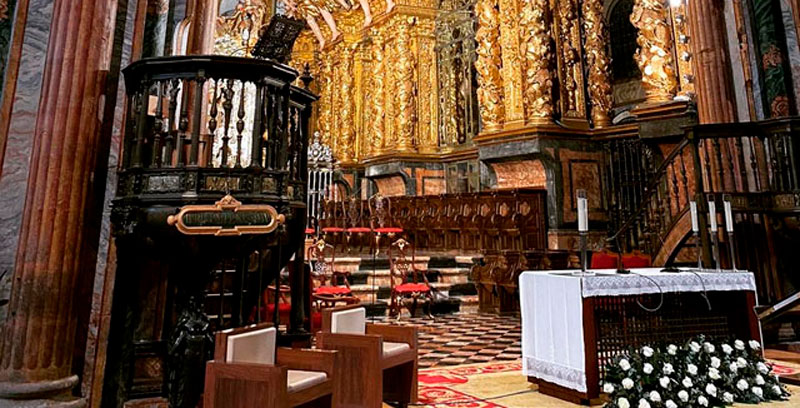
The Pilgrim Mass now speaks multiple languages
For centuries, the Cathedral of Santiago de Compostela has been a universal meeting point. A place where cultures, languages, personal stories, and spiritual motivations converge—first from across Europe and now from all five continents.
Every day beneath its vaulted ceilings, different accents can be heard and glances are exchanged among pilgrims who have walked hundreds of kilometers to reach the tomb of the Apostle Saint James in Compostela.
Now, this universal spirit is taking another step into the future. The Cathedral of Santiago has launched an innovative simultaneous translation service for the pilgrim mass in Santiago de Compostela using a mobile app powered by artificial intelligence.
This project blends tradition and technology so that no pilgrim misses part of this unique experience at the end of their Camino de Santiago because of language barriers or hearing limitations.
It is a tool designed to bring cultures and people together in one of the most emblematic spiritual spaces in the world.
The Cathedral of Santiago, always an international sanctuary
The Camino de Santiago is more international than ever. Data from the Pilgrim’s Office for 2025 clearly confirms this trend.
Although Spain remains the country with the highest number of pilgrims (43.44% of the total), more than half now come from abroad.
The main nationalities include:
United States (8.36%)
Italy (5.07%)
Germany (4.63%)
Portugal (4.34%)
United Kingdom (2.78%)
Mexico (2.30%)
Ireland (2.05%)
France (1.90%)
Australia (1.79%)
Canada (1.68%)
Brazil (1.60%)
Poland (1.58%)
South Korea (1.42%)
Argentina (1.30%)
Netherlands (1.28%)
Colombia (1.20%)
Taiwan (1.02%)
In total, more than half a million pilgrims received their Compostela certificate last year, coming from dozens of different countries with very diverse languages, cultures, and spiritual backgrounds.
The Pilgrim Mass, one of the most symbolic moments of the Camino de Santiago, brings together people every day who do not always understand the language in which the liturgy is celebrated.
For years, many pilgrims have participated devoutly without fully understanding the readings, the homily, or the prayers—enjoying mainly the multilingual greeting offered before the Mass.
This new app was created precisely to respond to that long-standing need.
At present, translations are available in German, English, French, Italian, and Portuguese. The technology is ready to expand gradually.
An app that preserves the solemnity of the Pilgrim Mass
The new simultaneous translation service works through a free mobile app, available on both the App Store and Google Play. Its design ensures that it does not interfere with the Pilgrim Mass or disrupt the atmosphere of reflection inside the cathedral.
Use is entirely individual. Each user only needs a smartphone and headphones. No additional installation or special devices are required.
The app offers two main modes:
Reading mode
Allows users to follow the Pilgrim Mass through real-time translated text displayed on their phone screen. Light and dark modes are available for visual comfort.
Audio mode
In this mode, the app translates the priest’s voice and transmits it through headphones using a natural-sounding voice, preserving the flow of speech and the spiritual experience.
In this way, pilgrims can fully participate in the celebration without breaking the silence or distracting other worshippers.
Artificial intelligence at the service of liturgy
Yes, artificial intelligence—now present in so many areas of daily life—has also reached the Pilgrim Mass of Santiago de Compostela.
At the heart of the system is a proprietary intelligent compression and synchronization algorithm. This is not a standard automatic translation tool, but one designed specifically for liturgical celebrations.
The algorithm analyzes natural pauses in speech, the priest’s rhythm, and the flow of the homily, automatically adjusting to reduce translation delay. As a result, the translated text or audio arrives almost simultaneously with the original voice.
This innovation greatly improves fluency and naturalness, overcoming one of the most common problems of simultaneous translation: excessive delay and loss of rhythm.
The app is also built to remain stable even when hundreds of users connect at the same time, something very common during peak pilgrimage seasons.
An inclusive and accessible tool
This project is not intended only for foreign pilgrims or those who speak languages other than Spanish. It also represents a significant step forward in accessibility.
People who are deaf or have hearing difficulties can follow the liturgy in written form on their phones, allowing them to participate fully without relying on others.
The Cathedral of Santiago thus responds to a daily reality: visitors with hearing impairments, international tourists, and pilgrims who—despite their devotion—do not understand the language used in the celebration. Until now, that language barrier limited their spiritual experience.
With this app, the Pilgrim Mass becomes a truly universal space.
Other uses of the app beyond the Pilgrim Mass
Although the application was designed primarily for liturgical celebrations, it can also be used for other events hosted by the Cathedral of Santiago:
Pastoral talks
Catechism sessions
Conferences
Institutional events
Cultural gatherings
This opens new possibilities for more open and participatory communication in a space that welcomes thousands of visitors every day.
The Cathedral of Santiago is reinventing itself without losing its identity. It remains a place of silence, prayer, and encounter—but now also a space where no one is excluded for linguistic or hearing reasons.
As the institution itself explains, the goal is “to help overcome language barriers and open doors to everyone who arrives, no matter where they come from, without losing the spiritual message or the sense of community.”
The Camino de Santiago adapts to the times
The Camino de Santiago has evolved over the centuries. From medieval pilgrims to those of the 21st century, the route has adapted to every era without losing its essence.
Today, pilgrims travel with mobile apps, digital reservations, and interactive maps—and now also with simultaneous translation for the Pilgrim Mass in Santiago de Compostela.
This project represents a modern, inclusive, and global Camino, where tradition and technology coexist naturally.
Buen Camino!