Some people picture the Saint James Way (Camino de Santiago) as a route through forests, villages and inland hamlets. And most of the time, it is. But in Galicia, the Way also smells of sea salt.
If you walk the Saint James Way in summer, you’ll find long stretches along the Galician coast — the longest in Spain — where you can take a dip and cool off after many kilometres on foot.
Where to take a dip without leaving your route on the Way
Several variants of the Saint James Way skirt estuaries, sandy shores and small coves where the pilgrim can pull off their boots, dip their feet in the water for a while, and continue their route with their batteries recharged. Or take a proper swim, of course.
Portuguese Coastal Way: the beaches of the Rías Baixas
This variant, which follows the Atlantic coastline from Portugal to Compostela, passes close to some of the most iconic summer beaches in Galicia. The Portuguese Coastal Way offers several excellent stretches of sand without straying far from the yellow arrows.
- Area Grande (A Guarda): right in the town centre of A Guarda, this pleasant beach is surrounded by restaurants — perfect for relaxing at the end of a stage, or before starting the next one if you’re an early-morning swimmer.
- Playa América, Panxón and Patos (Nigrán): after the medieval bridge at A Ramallosa, the route passes the magnificent sands of Panxón and Playa América. A little further on lies Praia de Patos. All three are highly sought-after beaches during the Galician summer.
- Praia de Samil (Vigo): shortly after, the route reaches the Samil inlet, Vigo’s beach of choice, preceded by other smaller but equally beautiful stretches of sand — especially since this area offers superb views of the Cíes Islands.
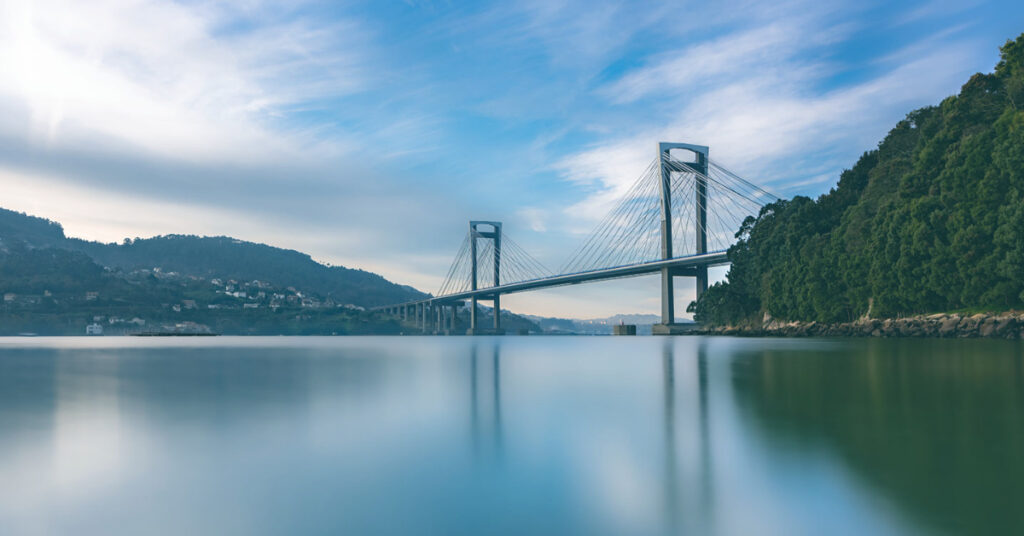
- Praia de Cesantes (Redondela): a beautiful beach over 2,400 metres long, with the added bonus of the incredible scenery of San Simón Bay, the Rande Bridge in the background, and the mysterious Isla de San Simón in between.
English Way: between city waves and quiet coves
The English Way sets off from A Coruña or Ferrol and, although it’s a shorter route, it doesn’t lack for sea moments.
- Orzán and Riazor beaches (A Coruña): pilgrims who choose the variant starting in A Coruña begin their stage with waves breaking alongside them, over a thousand metres of urban sand, plenty of facilities, and the Tower of Hercules in the background.
- Playa de la Magdalena (Pontedeume): you’ll pass this beach on the English Way if you set off from Ferrol, on the second stage, between Neda and Pontedeume.
Spiritual Variant: granaries and coves leading to the Traslatio
The Spiritual Variant of the Portuguese Way branches off in Pontevedra to recreate, several stages later, the sea voyage that carried the remains of the Apostle Saint James. Before boarding, pilgrims pass several beaches of the Rías Baixas.
- O Terrón and As Sinas in Vilanova de Arousa: Praia de O Terrón is one of the beaches pilgrims reach as they approach Vilanova, on the outskirts of town — ideal for a calm, family atmosphere, with gentle waters and golden sand. Surrounded by lush vegetation, it offers panoramic views over the estuary, calm and clear waters perfect for swimming, and activities such as kayaking and paddle surfing, plus a seafront promenade. Past the town centre lies Praia de As Sinas, with beach bars nearby and areas for a stroll.
- Illa de Arousa: if you feel like crossing the bridge (2 km from Vilanova), Illa de Arousa boasts some of the most spectacular beaches on the whole estuary: playa das Margaritas, playa dos Petóns and playa dos Espiños, as well as playa de Lameira, Lontreira and Punta Carreirón, with turquoise waters and white sand. And if you still have energy to walk a little further, you can reach Punta Cabalo, home to the lighthouse. Beside it sits a small beach, and a larger one that is among the prettiest on the island: Playa Area da Secada.
Father Sarmiento Route: the beachiest of them all
Although it isn’t an official Camino de Santiago, if you don’t want to lose sight of the sea for a moment, the Father Sarmiento Route is the Galician variant with the most consecutive beaches. It recreates the coastal itinerary the Benedictine friar walked in 1745 between Pontevedra and Santiago, staying close to the Pontevedra and Arousa estuaries the whole way.
It runs through places like Sanxenxo, Portonovo and O Grove, with countless beaches (Silgar, Montalvo, Paxariñas…), many of them Blue Flag beaches. But the queen of them all is A Lanzada, one of the best Atlantic beaches in Europe, nearly 3 kilometres long and much loved by surfers. Precisely because of this, watch out for the waves here — this isn’t the sheltered estuary, it’s the open sea, and the Ocean has a character of its own.
Again, if you’re walking this route — just as on the Spiritual Way — you can make a side trip to Illa de Arousa.
Way to Fisterra and Muxía: the Costa da Morte has beaches too
The Jacobean extension towards Fisterra and Muxía, starting from Cee, reveals more stretches of sand.
- Estorde, Sardiñeiro and Langosteira: between Corcubión and Fisterra, the Way runs almost right along the sea, linking these three beaches. Langosteira, the best known, was once where pilgrims bathed before reaching the cape to purify themselves ahead of the Lighthouse. It remains a classic stop today.
- Mar de Fóra and O Rostro (Fisterra): already in Fisterra itself, these two beaches open onto the Atlantic and have a wilder character, with regular swell and less shelter from the wind. They’re also two regular surfing spots on the Costa da Morte.
- Praia de Lires: on the stage between Fisterra and Muxía, the Way descends to this beach on Galicia’s smallest estuary — one of the quietest, least-crowded corners of the entire Jacobean extension.
- Playa de Lourido (Muxía): on the final stretch towards the sanctuary of A Virxe da Barca, the Way skirts this roughly 300-metre stretch of fine sand, flanked by a dune system, just before entering the village.
- Playa de Nemiña: it lies outside the official route, but for anyone with an extra day in Muxía, it’s a highly recommended excursion — considered one of the most beautiful beaches in Galicia.
Frequently asked questions about the beaches on the Saint James Way
Which beaches are along the Saint James Way in Galicia?
The Camino de Santiago passes several beaches in Galicia, such as Playa América and Samil on the Portuguese Coastal Way, Riazor and Orzán on the English Way, Combarro and O Terrón on the Spiritual Variant, and A Lanzada, Silgar and Montalvo on the Father Sarmiento Route.
Which variant of the Saint James Way has the most beaches?
Without being an official Camino, the Father Sarmiento Route is the Galician variant with the most consecutive beaches. It hugs the coastline between Pontevedra and Santiago, passing A Lanzada, Silgar, Montalvo, Paxariñas and the beaches of Illa de Arousa and Vilanova de Arousa, most of them Blue Flag beaches.
Can you walk the Camino de Santiago and swim in the sea?
Yes. On the Portuguese Coastal Way, the English Way, the Spiritual Variant and the Father Sarmiento Route, there are stretches that run right alongside beaches, so it’s entirely possible to plan your stage around a swimming stop without straying far from the route.
Which beach is near Santiago de Compostela to cool off after the Camino?
If you have a car, the closest option to Santiago would be the beaches around Noia. The beaches of Vilagarcía de Arousa (Compostela and La Concha), located in the town centre, are reachable by train — which possibly makes them the most convenient option once you finish the Camino de Santiago.
Which beaches does the Portuguese Way pass?
The Portuguese Coastal Way passes Playa América and Panxón, in Nigrán, and Praia de Samil, in Vigo, where you can spot the Cíes Islands before the route heads into the city.
What beaches are on the English Way?
Those setting off from A Coruña begin the stage right next to Riazor and Orzán beaches, in the heart of the city. From Ferrol, the route passes Playa de la Magdalena, in Pontedeume — a much quieter alternative.
Which beaches do you see on the Spiritual Variant of the Camino de Santiago?
The Spiritual Variant passes the beach of Combarro and, once in Vilanova de Arousa, O Terrón and As Sinas, right before boarding for the Traslatio. Two kilometres away, Illa de Arousa offers turquoise-water beaches such as das Margaritas or dos Petóns.
Every pilgrim, their own beach
In the end, there’s no single way to experience the Saint James Way (Camino de Santiago), and no single beach to recommend either. You might prefer the urban buzz of Riazor, the calm, family feel of O Terrón, the impossible blue of Illa de Arousa, or the vastness of A Lanzada. Whichever variant you choose, in summer, the sea is never too far away in Galicia.
Buen Camino!