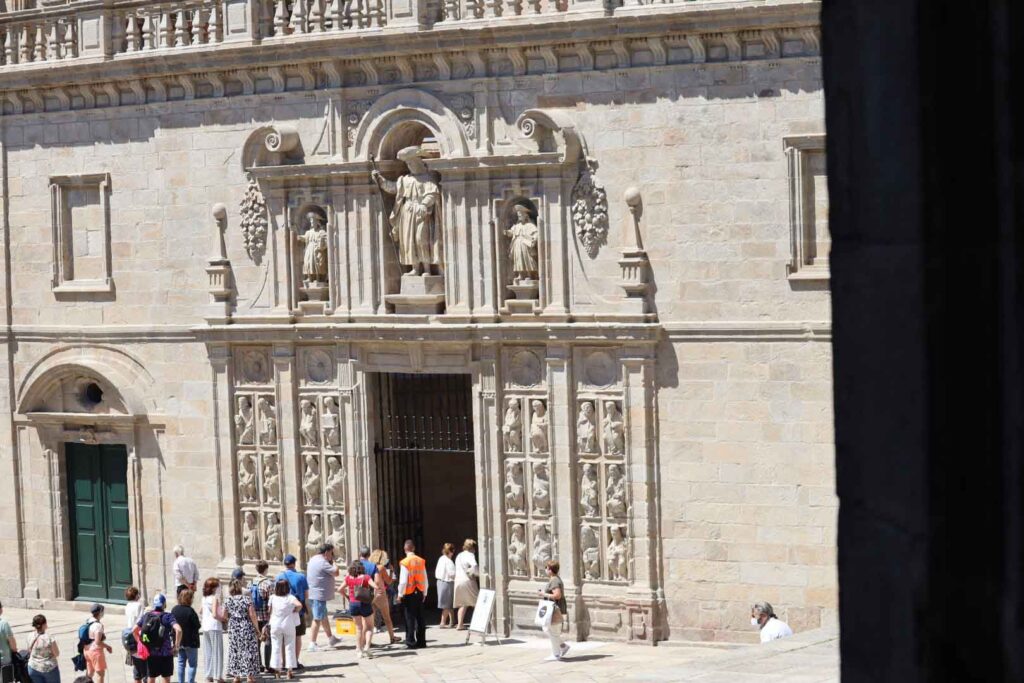
The Holy Door of the Cathedral of Santiago, also known as the Door of Forgiveness, is located on Quintana Square and opens only during the Compostela Holy Year, when July 25 falls on a Sunday. Its exact origin is uncertain and is placed around the 16th century. Its current façade is Baroque and reuses some of the sculptures from Master Mateo’s Romanesque stone choir. The opening ritual takes place on December 31. The Archbishop of Santiago strikes the door three times with a silver hammer, a symbolic gesture that recalls the time when the door was walled up. In 2027, the opening ceremony will be at noon on December 31, 2026. Walking through it is one of the requirements for receiving the plenary indulgence. Rutas Meigas organizes the Camino de Santiago so you can cross the Holy Door while enjoying the whole route to the fullest.
Normally, the pilgrims who walk to Santiago each year carry in their minds the desire to reach Obradoiro Square (Praza do Obradoiro) and see the imposing Baroque façade of the Cathedral. That is always the case, except in Holy Years, when the busiest square is Quintana. That is where the Holy Door stands, and from it 27 figures (12 on each side and 3 at the top) wait for the pilgrims. But this entrance hides much more.
A Holy Door not so big for an enormous promise
Holy doors are almost never the grand main doors of a church. They tend to be side entrances, narrow, almost humble. That is no coincidence. They evoke the “narrow gate” of the Gospel and remind pilgrims that the path of forgiveness is walked with humility, not with pomp or fanfare.
The Holy Door of Santiago de Compostela opens at the east end of the Cathedral, between the chapels of the Savior and Saint Peter, and leads into the ambulatory. That location has its charm. Whoever crosses it ends up a few steps from the high altar, the crypt of the Apostle and the medieval statue that pilgrims traditionally embrace. It is the most direct shortcut into the church, reserved exclusively for Holy Years.
The Holy Door of the Cathedral of Santiago and its origins shrouded in Mystery
If you were expecting an exact birth date, we’re sorry to disappoint you. No one knows for certain when or how the Holy Door came to be. What exist are two accounts that have competed for centuries, and we’re going to tell you both.
The Medieval Hypothesis: the Monks’ Door
According to the first hypothesis, the door would be the heir of a much older one, a minor entrance to the church that preceded the current Cathedral, which made it easier for the monks of San Paio, guardians of the Apostle’s tomb for centuries, to pass through. Some even trace it back to the pre-Romanesque church of the 11th century. The problem is that no evidence has survived to confirm it.
The Roman Hypothesis: Alexander VI and Archbishop Fonseca
The second hypothesis, the stronger one according to scholars, tells a different story. In the Rome Holy Year of 1500, Pope Alexander VI set the ritual of the holy doors: a blow of the hammer, a wall that falls, the pontiff crossing first. The idea caught on. Compostela, proud to be the world’s second jubilee city and always attentive to what was done in Rome, was quick to adopt it. Historians point to Archbishop Alonso III de Fonseca, during whose tenure the jubilees of 1507, 1512 and 1518 were celebrated, as the man who would have given the door its present meaning.
The Roman gesture, by the way, had already stirred popular fervor half a century earlier. A Florentine merchant wrote that, after the door of Saint Peter’s was opened in 1450, the faithful gathered the rubble from the wall to take home as relics. A custom that, according to specialists, also found an echo in Santiago.
A Baroque Façade built from the pieces of a lost treasure
What we do know for certain is that the door’s current appearance is Baroque, and that its history is tied to a great loss. Until the early 17th century, the center of the Cathedral housed the stone choir of Master Mateo, the Romanesque work of the same genius who sculpted the Portico of Glory. When it was dismantled, some parts were lost and some of its sculptures were reused.
In 1611, the master builders Jácome Fernández and González de Araújo transformed the façade and placed twelve figures of biblical characters, six on each side, from that choir. Around 1660, José Peña de Toro doubled the number, to twenty-four. And in 1694 the local sculptor Pedro del Campo crowned the ensemble with Saint James the Pilgrim and his disciples Theodore and Athanasius, also dressed as pilgrims. That is how the famous “twenty-seven of the Holy Door” came to be. In 1744, the iron grille that completes the exterior today was added.
Between the door itself and the Baroque portico, a small vestibule remained where a sepulcher and a few gravestones are still preserved. They are a reminder of another time, when the Quintana was a cemetery.
The Neoclassical Holy Door that never was
In 1794, Archbishop Malvar promoted a major neoclassical renovation of the Quintana and the east end of the Cathedral, including a large-scale Holy Door. The prelate’s death a year later, along with the cost of the project, put an end to the idea. Today we can only be grateful, since the humble door we know preserves the intimate character that its symbolism calls for.
December 31: the ritual of Opening the Holy Door
On December 31 before a Holy Year, the Quintana fills with pilgrims, faithful and church authorities. A procession led by the archbishop approaches the door.
The culminating moment arrives. The archbishop takes the silver hammer, strikes three times and is the first to cross the threshold. The Holy Door will stay open until the following December 31, when a similar ritual will close it until the next Jubilee.
For Holy Year 2027, the ceremony will take place on December 31, 2026, and this year it has been moved up to noon.
The Holy Door, from Leiro to Suso León’s Bronze
Outside of the Holy Year, the Holy Door stays closed by a door on its inner face and an outer grille. The inner door is made up of two bronze leaves, the work of Suso León, installed in 2003. Their reliefs tell the story of the life, martyrdom and translation of the Apostle Saint James. Before them, a wooden windbreak carved by Francisco Leiro in 1992, on the theme of the _Translatio_, occupied the spot, and it is now kept in the Cathedral Museum.
And sometimes the rule has been broken with the Church’s permission. In 2016, Pope Francis declared the extraordinary Jubilee of Mercy, and the Cathedral decided to open the door exceptionally during that year. Likewise, years later, it decided to extend the last Holy Year, 2021 to 2022, because of the coronavirus pandemic.
The hidden details of the Holy Door
If you ever cross the Holy Door of the Cathedral of Santiago, look out for these little secrets:
- The cross on the doorjamb: many pilgrims brush their fingertips against a small cross carved into the frame and then make the sign of the cross with water from the fonts.
- The two figures inside: Ezekiel and Saint Jude Thaddeus, both from Master Mateo’s choir.
- The Latin inscription: it recalls that this place is “the house of God and the gate of heaven,” a quotation from Genesis.
- The consecration cross of 1211: a testimony to the first consecration of the Cathedral, above the door.
- The stained-glass window of Saint James the Pilgrim (1896), which crowns the whole.
The Holy Door faces east and, therefore, toward Jerusalem, the place the Apostle Saint James departed from in the 1st century to preach the word of God.
What it means to cross the Holy Door
Behind so much stone and so much ritual lies a very simple idea, that of the words of the Gospel of John: “I am the gate; whoever enters through me will be saved.” Crossing a holy door is a rite of passage, leaving the old behind and starting something new. For the pilgrim who arrives on foot, it is the physical and spiritual culmination of the Camino de Santiago.
That said, it’s best not to confuse the symbol with grace. The Church reminds us that the jubilee is not earned simply by passing through the door, since the plenary indulgence requires meeting the conditions set for each Holy Year, which include, at a minimum, the confession of sins.
Reach the Holy Door by walking the Camino with Rutas Meigas
Although making a pilgrimage is not an essential requirement for obtaining the plenary indulgence, crossing the Holy Door after walking the Camino de Santiago is one of those unforgettable experiences.
At Rutas Meigas, a travel agency based in Santiago de Compostela, we take care of the accommodation, the luggage transfer between stages, and everything you need for your pilgrimage. With Holy Year 2027 approaching, it’s best to plan ahead.
Want to cross the Holy Door in Holy Year 2027? Rutas Meigas takes care of everything for you. Contact us
Buen Camino!
Frequently Asked Questions About the Holy Door of the Cathedral of Santiago
Can I cross the Holy Door when it’s not a Holy Year?
No. Outside the Jubilee Year, the door stays closed by an inner door and an outer grille. It opens only in Compostela Holy Years, when July 25 falls on a Sunday, although the Pope may declare extraordinary holy years, as happened in 2016 and 2022.
When will the Holy Door open for Holy Year 2027?
On December 31, 2026, with a ceremony presided over by the Archbishop of Santiago that will be held at noon this year. The door will close on December 31, 2027.
Who made the figures of the Holy Door?
Most come from the old stone choir of Master Mateo, reused in the 17th century. The figures of Saint James the Pilgrim, Theodore and Athanasius are the work of the local sculptor Pedro del Campo (around 1694). Together they make up the so-called “twenty-seven of the Holy Door.”
Is the current Holy Door the original from the 16th century?
Not quite. Its origin dates back, in all likelihood, to the 16th century, but its exterior appearance is Baroque (17th century) and the current bronze leaves date from 2003, the work of Suso León.
Do I have to cross the Holy Door to receive the plenary indulgence?
Crossing it is the most symbolic gesture of the Holy Year, but the Church reminds us that the jubilee is not earned simply by passing through it. You must also receive the sacrament of confession and Eucharistic communion, as well as pray devoutly for the Pope’s intentions.
Rutas Meigas | Camino de Santiago Travel Agency, Routes and Hiking in Galicia | rutasmeigas.com