Some wine regions are born of ease: flat land, simple mechanisation, economies of scale. And then there is the Ribeira Sacra. Here, wine was born not of convenience but of necessity, of faith, and of an almost supernatural stubbornness in coaxing fruit from slopes that the rest of the world would have written off as impossible. A territory where every bottle carries the imprint of a civilisation that chose to plant vines where no logic justified it — and where the result is a wine that tastes, literally, of mountain, slate, river and centuries.
At Rutas Meigas we have been in love with this landscape and its people since 1998. And since that very same year we have shared our path with Adega Algueira, a family winery that is exactly the same age as us, and that represents, better than any other, the spirit of this land: deep, authentic, heroic.
The Ribeira Sacra and wine: a two-thousand-year story
The winemaking history of the Ribeira Sacra stretches back at least to Roman times. When Rome’s legions advanced into the northwestern corner of the Iberian Peninsula in the first century BC, they found in the valleys of the Sil and Miño an extraordinary landscape for viticulture: steep south-facing slopes that captured maximum solar radiation, slate soils with perfect drainage, and the thermoregulating influence of the rivers that created a unique microclimate, sheltered from Atlantic excesses and continental frosts.
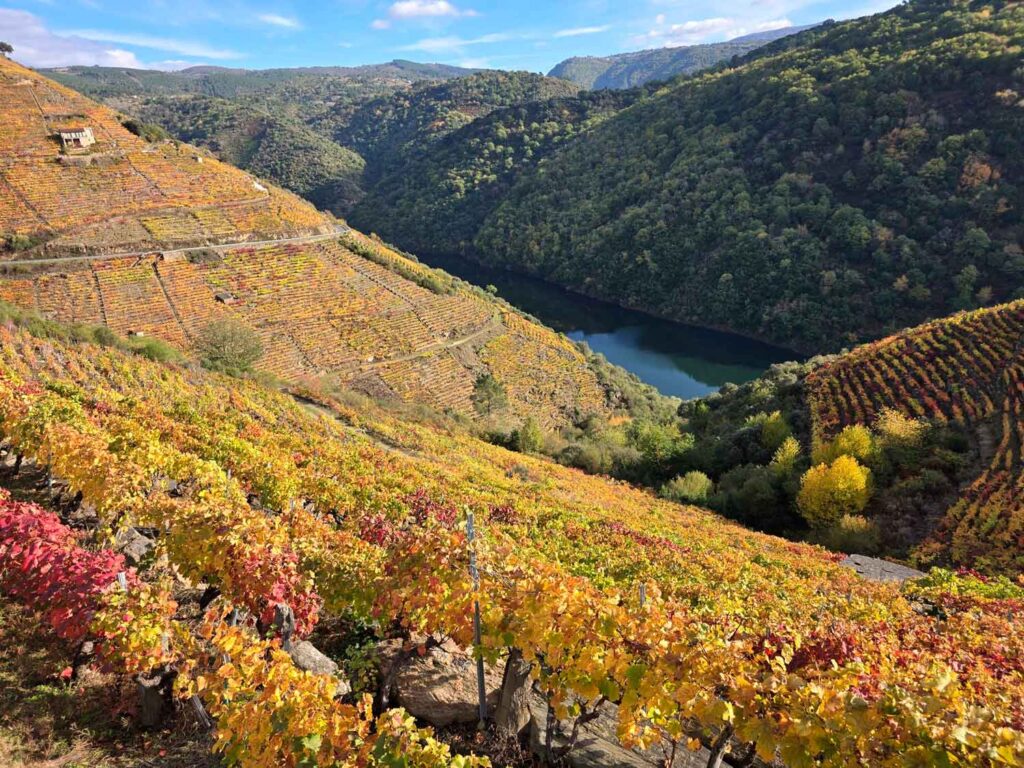
The Romans wasted no time. They began terracing the slopes with dry-stone walls, creating the stepped bancales that are today the most recognisable visual symbol of the Ribeira Sacra. But it was the medieval monks who turned viticulture into the economic and spiritual backbone of the entire region. From the 6th and 7th centuries onwards, the hermits who settled along these riverbanks found in wine not only an essential foodstuff but an indispensable liturgical element. The great monasteries — Santo Estevo, Santa Cristina, San Paio de Abeleda, Montederramo — became the first large organised wine producers, developing cultivation and winemaking techniques that laid the foundations for what we now call heroic viticulture.
The term “heroic” is neither rhetorical nor marketing spin. The International Organisation of Vine and Wine (OIV) defines heroic viticulture as farming practised under extreme conditions: slopes exceeding 30%, altitudes above 500 metres, narrow terraces that prevent mechanisation, or a combination of these factors. In the Ribeira Sacra, virtually the entire vineyard area meets one or more of these criteria. Slopes that in some places exceed 70% mean that every harvest is a physical and logistical feat that only passion and generational knowledge can accomplish.
During the Middle Ages, wine production in the Ribeira Sacra reached levels that would surprise us today. Historical records describe a region intensively cultivated, with vineyards covering slopes that are now largely abandoned or reclaimed by forest. Decline came with the 19th-century ecclesiastical confiscations that dismantled the monastic system sustaining viticulture for centuries, and deepened with the rural exodus of the 20th century, when thousands abandoned these valleys for work in cities and abroad.
Recovery arrived in the 1980s and 90s, driven by a group of vintners with vision, determination and a profound love for their land. The granting of Denominación de Origen status to Ribeira Sacra in 1996 was official recognition of what those pioneers already knew: that these wines, made with the indigenous Mencía variety and with other nearly forgotten varieties such as Merenzao, Brancellao, Godello and Treixadura, possessed a personality and quality that the national and international market had yet to discover. What followed would become an unprecedented success story in Spanish wine history.
The Wine Landscape: why the Ribeira Sacra is unique in the world
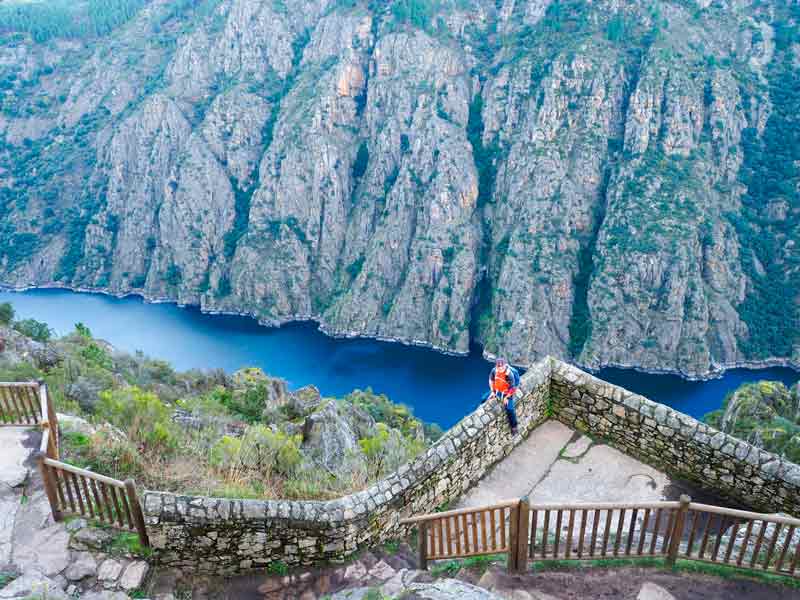
To understand Ribeira Sacra wine, one must first understand its landscape. The Sil and Miño rivers have carved their way through the Galician mountains over millions of years, creating canyons up to 500 metres deep that are, without question, one of the most impressive geological spectacles on the entire Iberian Peninsula. The canyon slopes, covered in dark slate that absorbs heat during the day and releases it slowly at night, create an ideal thermal environment for grape ripening.
Slate is, in many ways, the soul of Ribeira Sacra wine. This type of soil, poor in nutrients but rich in minerals, forces the vines to drive their roots deep into the rock in search of water and sustenance. The result is a vine that struggles, that fights, and in that struggle concentrates in its clusters an aromatic intensity and a mineral complexity that is virtually impossible to achieve in more generous soils. When wine lovers speak of the “minerality” of a Ribeira Sacra Mencía, they are speaking, literally, of slate: that taste of wet stone, of flint, of geological depth that no other Iberian terroir reproduces in quite the same way.
All of this is complemented by the Ribeira Sacra Denominación de Origen, which encompasses five differentiated sub-zones with their own characteristics: Amandi, Chantada, Quiroga-Bibei, Ribeiras do Miño and Ribeiras do Sil. Each produces wines with different nuances depending on altitude, slope orientation, soil composition and local microclimate. This internal diversity is another of the DO’s great assets, allowing a wine enthusiast to spend years exploring its different expressions without exhausting the surprises.
Adega Algueira: when wine is a vocation and a legacy
In 1998 — the same year Rutas Meigas opened its doors to the world — Fernando González planted the first vines at Doade, on the banks of the Sil, in what would become Adega Algueira. But the real story begins earlier: in 1979, when Fernando discovered an old vineyard hidden among stone-walled terraces at Carballo Cobo, a plot that captivated him from the very first moment and would become the spiritual and physical origin of the entire winery.
The story of Algueira is the story of a recovery. When Fernando began working the Sil vineyards, he found abandoned plots, crumbled walls, old vines barely surviving among scrub. What others saw as a landscape in decline, he saw as a heritage to be rescued. Every vine recovered, every terrace wall rebuilt, every nearly-forgotten variety that bore fruit again was a small victory against oblivion and abandonment.
Algueira’s philosophy rests on three pillars that perfectly summarise the winery’s spirit. The first is recovery and protection: rescuing historic vineyards and conserving the slate soils and century-old terraces that form part of the living memory of the Ribeira Sacra. The second is celebrating diversity: beyond the ever-present Mencía, Algueira works with Merenzao, Brancellao, Sousón, Caíño, Godello, Treixadura and other indigenous varieties that enrich the vinous identity of the region. The third is innovating from tradition: researching, experimenting and creating wines that surprise, always faithful to the terroir and respectful of nature.
The result of this philosophy is a range of wines that are, in themselves, a map of the Ribeira Sacra. Each Algueira label responds to a question, an exploration, a specific vineyard or a rediscovered variety, a collection that is at once a catalogue of nearly-forgotten varieties and a declaration of love for this land.
Wine Tourism in the Ribeira Sacra: living wine from the Inside
The Ribeira Sacra is, increasingly, a first-class wine tourism destination. Not only because its wines are exceptional, but because visiting this region uniquely combines oenological pleasure with immersion in a landscape that is, in itself, a work of art. The heroic vineyards hanging above the Sil canyons are not just a picturesque backdrop: they are the indispensable context for understanding why the wine produced here tastes the way it does.
Combining Wine Tourism and Hiking: the Rutas Meigas approach
At Rutas Meigas we believe that wine and hiking are two complementary and deeply Galician ways of relating to a territory. Walking the Ribeira Sacra — through routes like O Camiño do Monxe or any of the comarca’s other trails — and stopping to discover its wineries, its wines and its people, is the most complete way of understanding this place.
The partnership between Rutas Meigas and Adega Algueira has been built over more than 25 years with the same philosophy: offering travellers authentic experiences that connect them with the best of Galicia. When we organise routes through the Ribeira Sacra, a visit to Algueira is one of those stops we consider essential — not as a tourist add-on but as a central experience, capable of adding a layer of understanding and enjoyment that transcends the simple tasting of a wine.
- Hiking routes through the Ribeira Sacra with stops at selected wineries
- Guided visits to Adega Algueira with tasting included
- Boat trip through the Sil Canyon
- Traditional lunch
- Combination with O Camiño do Monxe or other routes in the region
- Private room accommodation with en-suite bathroom and luggage transfer
Everything organised by Rutas Meigas so that the traveller need not worry about a single logistical detail and can focus exclusively on what matters: discovering the Ribeira Sacra from within.
The Ribeira Sacra on the International Wine Tourism Map
In recent years, the Ribeira Sacra has leapt from being a relatively unknown region outside Spain to being regularly cited by the most influential wine guides and publications in the world. Algueira’s wines, like those of other benchmark wineries in the DO, have appeared on the wine lists of Michelin-starred restaurants across Europe and the Americas, and Ribeira Sacra Mencía has become a standard reference in discussions about the most interesting Spanish reds of the present day.
This international recognition has driven a quality wine tourism that attracts enthusiasts from across the world. Visitors from Germany, the United Kingdom, the United States, Japan and the Nordic countries travel specifically to the Ribeira Sacra to explore its vineyards, visit its wineries and walk its trails. The region uniquely combines what many wine tourism destinations offer separately: great wines, extraordinary landscapes, millennia of history, excellent gastronomy and a cultural authenticity that mass tourism has not yet eroded.
Fancy discovering the Ribeira Sacra among vineyards and canyons? Rutas Meigas makes it possible. Write to us at info@rutasmeigas.com or call +34 881 019 941.
Because Ribeira Sacra wine cannot be explained: it must be walked, navigated, smelled and drunk. And then, inevitably, missed. Because as they say in Galicia: witches don’t exist — but in the Ribeira Sacra, if they do, they’re here.
Rutas Meigas | Specialists in Camino de Santiago and hiking in Galicia | rutasmeigas.com