If you think reaching Santiago de Compostela on foot today can sometimes be challenging — even with Google Maps, which honestly will not help much on certain stretches — imagine what it was like in the Middle Ages, when pilgrims had no maps at all.
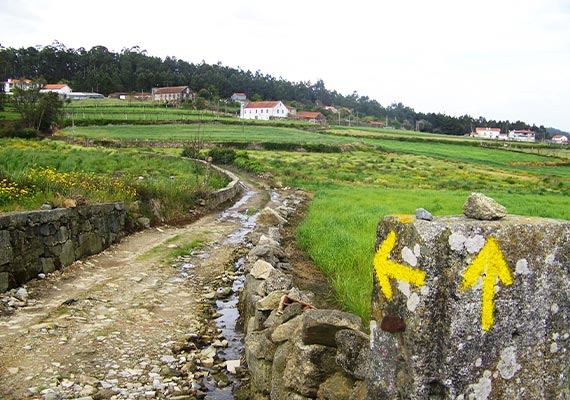
Today, along many sections of the Camino de Santiago, pilgrims simply follow the famous yellow arrows. Every time you spot one, you know you are on the right path, that the Saint James Way continues in that direction.
But those yellow arrows are actually quite recent. And we owe them to Elías Valiña Sampedro, the parish priest of O Cebreiro who, armed with cans of yellow paint and a tiny Citroën 2CV, changed the history of the Camino de Santiago forever.
The priest of the first Galician village on the Camino Francés
Elías Valiña was born in 1929 in Mundín, a small hamlet near Sarria, in the province of Lugo. He was ordained as a priest in 1957 and assigned to the parish of Santa María la Real de O Cebreiro, the iconic mountain village of stone pallozas and perpetual mist where the Camino Francés enters Galicia. There he would live, work, and eventually die. He spent thirty-two years serving the same parish, with a dedication that went far beyond ordinary religious duties.
Valiña was a highly educated man. He earned a degree in Canon Law from the Pontifical University of Comillas and later completed his doctorate at the University of Salamanca. As early as 1961–62, he wrote his doctoral thesis titled “The Camino de Santiago: A Historical-Legal Study,” becoming one of the first scholars to approach the pilgrimage route with true academic rigor.
At that time, the Camino de Santiago was little more than a fading memory. Many stretches had disappeared beneath vegetation, and the few pilgrims who dared to attempt the route frequently got lost. The medieval pilgrimage tradition seemed destined to vanish.
The story of the yellow arrows on the Camino de Santiago
In 1984, Elías Valiña undertook the task that would immortalize him: the complete waymarking of the Camino Francés from Roncesvalles to Santiago de Compostela.
He climbed into his small Citroën 2CV, loaded it with cans of paint, and drove hundreds of kilometers along the pilgrimage route, stopping at every crossroads, every fork, and every place where a pilgrim might hesitate.
And there, he painted a very simple symbol to indicate the direction forward: arrows.
The color itself, like many great ideas throughout history, comes with its own legend. Some say the priest bought leftover yellow paint from roadwork projects at a very low price and simply used what was available. His nephew and close collaborator, José Manuel López Valiña, offers a less accidental explanation: according to him, the priest had observed in France that yellow was commonly used to mark mountain hiking trails and consciously chose it because of its high visibility and durability.
Whether coincidence or vision, the result was the same: yellow became the universal language of the Camino de Santiago.
And, of course, there is also the anecdote that history has transformed into legend. According to the story, while painting yellow arrows in the Pyrenees, Elías Valiña was stopped by the Guardia Civil, suspicious of the mysterious markings appearing throughout the mountains.
“What are you doing?” they asked him.
The priest’s answer was as dry as it was unexpected:
“I am preparing an invasion.”
Only instead of soldiers, the invaders would be pilgrims.
Much more than a yellow arrow pointing toward Compostela
The yellow arrow is Elías Valiña’s most visible legacy, but his work went far beyond waymarking.
He promoted the restoration of the historic village of O Cebreiro, a project that culminated in 1971 with the inauguration of its Ethnographic Museum. He recovered lost stretches of the Camino in Galicia, cleared overgrown paths, created maps, and wrote pilgrimage guides.
Between 1985 and 1987, he personally edited and published the Boletín del Camino de Santiago, a modest but essential newsletter for the emerging network of pilgrims and Camino associations.
He was also a tireless hospitalero. He reopened the pilgrims’ hostel in O Cebreiro and managed it together with his family, welcoming the few pilgrims who ventured along the route during those years.
In 1985, during the First Jacobean Gathering held in Santiago de Compostela, he was unanimously appointed Commissioner of the Camino de Santiago. Two years later, he organized the International Congress of the Camino de Santiago in Jaca, where the foundations were laid for the Camino’s recognition as a European Cultural Itinerary — a title officially granted by the Council of Europe later that same year, 1987.
Always on the Camino
Elías Valiña died on December 11, 1989, at the age of 60, after suffering from cancer.
The first Holy Year in which the Camino de Santiago would once again overflow with pilgrims — the famous Xacobeo 1993 — arrived four years after his death. He never lived to see the full impact of his work.
It is said that before he died, he made one final request to his family: to ensure that the yellow arrow would never disappear from the Camino.
His nephew José Manuel, together with British writer and historian Laurie Dennett, continued the mapping project that the priest had left unfinished.
Today, Elías Valiña rests in the basilica of Santa María la Real de O Cebreiro. On the stone marking his grave, only three words are engraved in Galician:
“Sempre no Camiño” — “Always on the Camino.”
The yellow arrow followed by hundreds of thousands of Pilgrims
Every time you look up and see a yellow arrow painted on a wall, a tree trunk, or the arch of an old bridge, you are following the spirit of that mountain priest who, at a time when the Camino de Santiago was little more than a forgotten trail, decided to bring it back to life.
On our Camino de Santiago routes, we stop in O Cebreiro not only to admire its ancient pallozas — sometimes covered in snow — or the mist rising from the valleys. That place also tells the story of the priest who, with nothing more than cans of yellow paint, marked the way forward for generations of pilgrims.
Because of his enormous legacy, a documentary was made about his life: “Elías Valiña, the Inventor of the Yellow Arrows.” On February 2nd, 2025, the first-ever Elías Valiña Sampedro Day was celebrated, coinciding with the 96th anniversary of his birth, with commemorative events in Sarria and the unveiling of a memorial plaque at his birthplace in Mundín.
Today, Elías Valiña is no longer simply part of the Camino de Santiago. He is part of its history.
Buen Camino!