
Would you like to receive a personalized
quote by email?

Starting at
2985 € *

Distance
743 km

Duration
40 days / 39 nights

Difficulty
Medium

Regime
Bed and breakfast

Type of Accommodation
Private room with bathroom

Service
Backpack transport

Transfer
As marked on the itinerary
* Price per person, based on double occupancy.
Camino de Santiago with Support

Camino francés from Roncesvalles to Santiago
Camino francés from Roncesvalles to Santiago
Camino Francés from Roncesvalles to Santiago de Compostela
Camino Francés from Roncesvalles to Santiago de Compostela starts at the point where the old medieval roads that began from inside Europe converged. In this French Way from Roncesvalles to Santiago de Compostela we will begin a thirty-seven day journey along the most traditional route of the Camino de Santiago, the French Way.
History
Many of the places that we will pass on our pilgrimage during this Camino Francés from Roncesvalles to Santiago de Compostela were created and grown in the shadow of the Camino de Santiago. Cities like Burgos, León and Roncesvalles themselves. Small towns like O Cebreiro also owe much of their history to the Jacobean tradition.
Over the centuries, people of all nationalities have traveled the Camino de Santiago along this route. Goethe said in the 19th century that “Europe was created by the pilgrimage to Compostela”. It was declared a World Heritage Site by UNESCO in 1993 and currently shares this distinction with the Camino Primitivo and the Camino del Norte.
Our route along the French Way from Roncesvalles to Santiago de Compostela
The route begins in a mountainous area with stages of different slopes. We will gradually enter the Castilian plateau. This is a flat area with no bumps on the orography but in summer this can test our resistance to high temperatures. We will cross four autonomous communities until we come to Galicia through the mythical ascent of the “Cuesta de la Faba”. Once there, its green landscapes will accompany us to Santiago de Compostela.
The French Way is an essential route for pilgrims who choose to go to Compostela. One tour at once becomes an unforgettable experience. It will undoubtedly be a challenge for our bodies and our feet. Few of us are used to driving an average of twenty kilometers a day on so many consecutive days. However, the value of the experience, the immense beauty of the landscapes and the cultural richness of the route are undeniable reasons for the effort. Without forgetting the gastronomy!
Camino Francés from Roncesvalles path options
Pilgrims who do not have enough time to complete the 37 consecutive days can take the same route of the French Way from Roncesvalles, which is divided into five sections of seven to eleven days each.
¡BUEN CAMINO!
Arrival in Roncesvalles
We are in the Navarrese Pyrenees, where the old medieval streets that started in the interior of Europe came together and are now the traditional starting point of the modern way in Spanish territory. The architecture, the interesting monuments, including the Collegiate Church of Santa María from the 13th century, the house of the beneficiaries or the old hospital of Itzandegia are very worth seeing.
Arrive in Roncesvalles on your own.
Accommodation in Roncesvalles.
Roncesvalles - Zubiri
Difficulty level: medium.
The first day of the French way from Roncesvalles follows a typical mountain route, but it does not pose any major difficulties. Almost the entire stage descends, although we have to climb two climbs: the high Mezkiriz and the Alto de Erro.
Accommodation in Zubiri / Akerreta.
Zubiri - Pamplona
Difficulty level: easy.
We continue downhill, over gentle hills and leave the mountain path behind us. On today’s stage we will pass through an important medieval town that has grown under the guise of the Larrasoaña pilgrim pass. We will also cross the Arga River several times over numerous bridges. Once in Pamplona, it is inevitable to mention the famous Saint Fermín festivities. But in every season this city is worth seeing with its important monumental complex, which is dominated by churches and medieval walls.
Accommodation in Pamplona.
Pamplona-Puente la Reina
Difficulty level: medium.
The most important landmark of this stage is the Alto del Perdón, although the climb is not without, with a height difference of 260 meters. The descent is a bit more rugged, quite rocky and therefore a bit slippery. Once at the top, we have to take a short break to enjoy the view. It is quite a windy area, so on the summit we find not only the pilgrimage monument, but also the company of windmills.
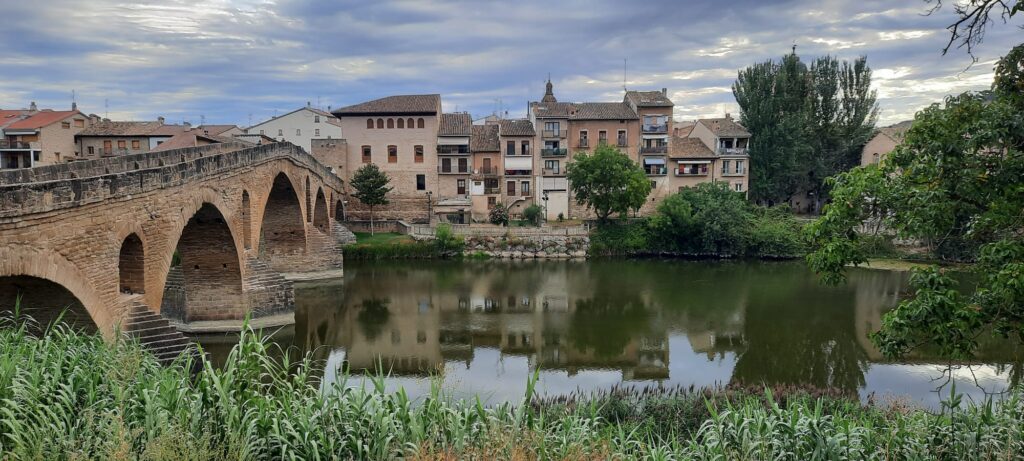
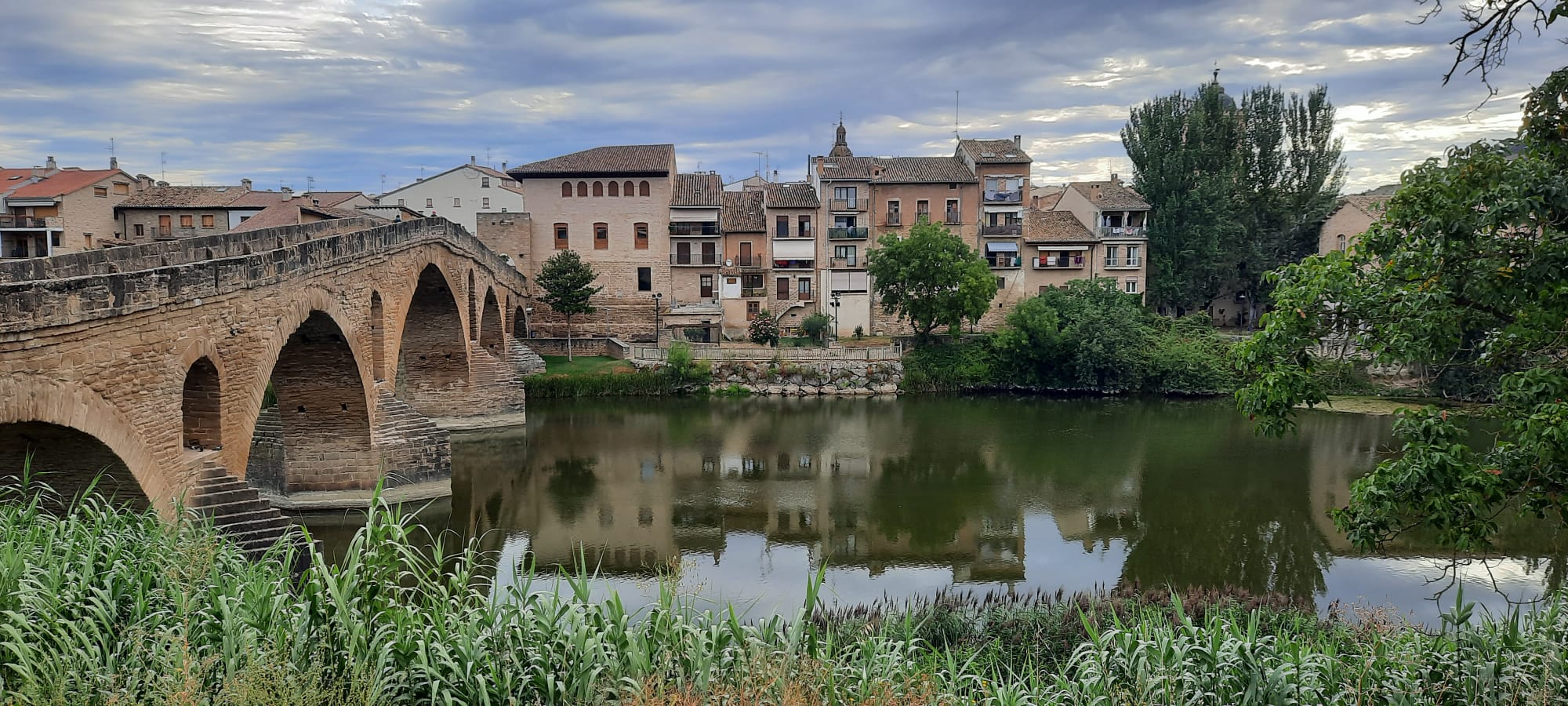
In Puente La Reina it is worth visiting the large medieval bridge with its five arches, the 14th-century Church of San Pedro and the Comendadoras de Sancti Spiritus monastery.
Accommodation in Puente La Reina.
Puente la Reina - Estella
Difficulty level: medium.
We will start the stage with a gentle descent of almost 5 kilometers in order to face the ascent to Mañeru, which is not very long but has quite a difference in altitude. Then we walk through the town of Cirauqui, where the medieval Gothic church and the Roman road stand out, of which some original sections are still preserved. The last section of the stage, which leads us to Estella, goes down again.
Accommodation in Estella.
Estella-Los Arcos
Difficulty level: medium.
Stage with very cheap footpaths. Immediately after leaving Estella, we find the famous “wine fountain”. The last 12 kilometers from Villamayor de Monjardín to Los Arcos, although easy to walk, can be a bit difficult between farmland and side streets, with hardly any shade, which is why we should start early, especially in the summer months, to avoid the greatest heat.
Accommodation in Los Arcos.
Los Arcos-Logroño
Difficulty level: medium.
This stage has a comfortable start on dirt roads, which make the first route very pleasant. The olive groves and almond trees, but above all the vineyards, accompany us at the entrance to the land of wine par excellence, La Rioja. The middle part of the stage is much more abrupt and will cause us some difficulties. Before we reach the end of the stage, we pass the ruins of Clavijo Castle. The last stretch is easy to walk on pedestrian paths. In Logroño we should not miss the opportunity to take a stroll along Calle Laurel to taste some good local wines accompanied by delicious tapas.
Accommodation in Logroño.
Logroño-Nájera
Difficulty level: medium.
In today’s stage we find two important climbs, the Alto de la Grajera and the Alto de San Antón. The good news is that both are rising fairly evenly, and therefore are not very difficult.
Accommodation in Nájera.
Nájera-Santo Domingo de la Calzada
Difficulty level: easy.
We will hike between rural and paved trails, which in turn will be a fairly comfortable stage. The vineyards that have accompanied us in the past few days will gradually give way to grain fields. The end of the day will be in Santo Domingo de la Calzada, one of the cities with the longest tradition and the Jacobean footprint, whose historical center is made up of medieval streets.
Accommodation in Santo Domingo de la Calzada.
Santo Domingo de la Calzada-Belorado
Difficulty level: easy.
In this stage we leave La Rioja and drive to Castilla León. Despite two stops, La Grajera and San Antón, it will be another pleasant day on the Way of St. James, as the ascent is very even. Once in Belorado, we see the last mountains before entering the large Castilian plateau.
Accommodation in Belorado.
Belorado - Villafranca Montes de Oca
Difficulty level: medium.
This will be a stage with a very calm first part, which runs along natural paths and tracks. When we reach the Montes de Oca, we will find ourselves with an unevenness of about 200 meters with a simple attack, although we must begin to take into account that we have been walking for ten days on our feet.
Accommodation in Villafranca Montes de Oca.
Villafranca Montes de Oca - Atapuerca
Difficulty level: medium.
The Sierra de Atapuerca offers us good views of the area and a very pleasant and quite comfortable route. We come across some forests and areas planted with wheat.
Shortly before reaching Atapuerca, we will pass through San Juan de Ortega, a Spanish Gothic jewel and next to one of the most important archaeological sites in the world.
Accommodation in Atapuerca
Atapuerca-Burgos
Difficulty level: medium.
The Sierra de Atapuerca offers us a good view of the surroundings and a very pleasant and quite comfortable route. We pass one of the most important archaeological sites in the world. Access to the city of Burgos via the river path is recommended, much more pleasant than the possibility of walking through the industrial area. Once in the city, a visit to the Gothic cathedral is essential.
Accommodation in Burgos.
Burgos-Hornillos del Camino
Difficulty level: medium.
Despite the fact that we have already entered the Castilian plateau and the sections that await us are flat and apparently comfortable, the climatic difficulties now arise somewhat, as the temperatures in summer are usually very high, there are only a few shady spots and in winter the temperatures are very low. The weather conditions are rewarded by medieval towns that we find along the way.
Accommodation in Hornillos del Camino.
Hornillos - Castrojeriz
Difficulty level: medium.
The profile of this stage is similar to the previous one, in which we must take into account the climatic difficulties of the Castilla fields with high temperatures in the summer months, which make the hike difficult. The last kilometers of the section are on the road. In Castrojeriz we can visit the Santa María del Manzano Collegiate Church and its interesting museum of sacred art.
Accommodation in Castrojeriz.
Castrojeriz-Frómista
Difficulty level: medium.
When we leave Castrojeriz, we find the Mostelares, with a height difference of 145 meters on less than two kilometers. This will be the biggest challenge of this stage, but it offers us a wonderful view of the entire plateau. The end of the stage will be in one of the capitals of the Jacobean tradition and the capital of the Romanesque Palencia, the city of Frómista.
Accommodation in Frómista.
Frómista-Carrión de los Condes
Difficulty level: easy.
Very flat stage that crosses the plateau and poses no difficulties. We will drive through the town of Villalcázar de Sirga, where we must visit the monument of Mesonero, which has regained the tradition of the Way of St. James and Jacobean gastronomy, as well as the church of Santa María La Blanca. In Carrión de los Condes, a visit to the San Zoilo monastery is essential.
Accommodation in Carrión de los Condes.
Carrión de los Condes-Calzadilla de la Cueza
Difficulty level: easy.
We are now on the stage of the French route, on which we will find the fewest stops, although we will hike on Via Aquitaine, the Roman road XXXIV or the Asturica Burdigalam (Astorga-Bordeaux).
Accommodation in Calzadilla de la Cueza.
Calzadilla de la Cueza-Sahagún
Difficulty level: medium.
When we leave Calzadilla de la Cueza, we find a short climb of about two kilometers. We will also hike through small valleys and cross the Valderaduey river once we are in the province of León. We end the trip in the city of Sahagun in Mudéjar, one of the most unique on the Camino de Santiago, where the churches of San Tirso and San Lorenzo stand out.
Accommodation in Sahagún.
Sahagún-El Burgo Ranero
Difficulty level: medium.
We leave Sahagún and cross the river Cea towards Bercianos del Camino to finally arrive in El Burgo Ranero. It is a comfortable journey between grain fields.
Accommodation in El Burgo Ranero.
El Burgo Ranero - Mansilla de las Mulas
Difficulty level: easy.
Very flat stage that runs practically straight. We walk on comfortable dirt roads and through a forest area that offers us a pleasant shade, especially in the summer months. We will hardly find populations between the two points. In Mansilla de las Mulas we can relax on the banks of the Esla river.
Accommodation in Mansilla de las Mulas.
Mansilla de las Mulas-León
Difficulty level: easy.
So this stage ends in one of the capitals of the Way of St. James
It runs near roads with more traffic than the previous ones. The Portillo hill with its wonderful view will anticipate our arrival in the city. Once in León, a visit to the cathedral, Gaudí’s Casa Botines and the Hospital de San Marcos are a must. A walk through the old town and a stop in the Barrio l Humedo are also highly recommended, in order to fortify yourself with delicious tapas after the hike.
Accommodation in León.
León - Oncina de la Valdoncina
Difficulty level: easy.
We leave the city of León along a practically flat section of the Camino de Santiago, which runs through the towns of San Miguel or Fresno, once again between cereal fields, characteristic of the area.
Accommodation in Oncina de la Valdoncina.
Tag 24 Oncina de la Valdoncina - Hospital de Órbigo
Difficulty level: easy.
We walk through a landscape plagued with cultivated fields through which we continue touring the Castilian plateau. These stages of the Camino de Santiago, of very flat orography, can become a bit tiring, not because of the difficulty of the orography, since it is nil, but because so much plain can give the sensation that we are not moving forward. But we do.
Accommodation in Hospital de Órbigo.
Hospital de Órbigo - Astorga
Difficulty level: medium.
At this stage we will begin to recover the unevenness in the terrain, which will be greater as we get closer to Galicia. Once we leave Hospital de Órbigo we come across slightly mountainous terrain. Our goal will be the small city of Astorga, full of remains from Roman times, and where the French Way and the Vía de la Plata come together and which is also the capital of the Maragatería region.
Accommodation in Astorga.
Astorga-Rabanal del Camino
Difficulty level: medium.
We are now penetrating ever deeper into the Montes de León. In this phase we will find ever larger hills in the further course.
Accommodation in Rabanal del Camino.
Rabanal del Camino - El Acebo de San Miguel
Difficulty level: medium – high.
At this stage, we leave the Maragatería region behind to enter El Bierzo. This also means that we return to the unevenness typical of mountainous areas. The first of the ascents will take us to a mythical place on the Camino de Santiago, the Cruz de Ferro on Mount Irago, the highest point of the French Way, at 1,500 meters.
Accommodation in El Acebo de San Miguel
El Acebo de San Miguel- Ponferrada
Difficulty level: medium – high.
We are in the heart of the Bierzo Region, well known for its rich gastronomy, with typical dishes such as botillo and, above all, for its wines, with their own denomination of origin. The Camino de Santiago will take us at this stage to the city of Ponferrada, capital of the region and a place of enormous Jacobean tradition where we can visit the Castle of the Templars.
Accommodation in Ponferrada.
Ponferrada-Villafranca del Bierzo
Difficulty level: medium.
In the middle of the Bierzo region, this stage leads over quite comfortable hiking trails. Again we encounter landscapes with fields and vineyards. In Villafranca del Bierzo we can visit the Church of Santiago, known for the Puerta del Perdón, which opened only in the Jacobean years, as well as the Holy Door of the Cathedral of Santiago.
Accommodation in Villafranca del Bierzo.
Villafranca del Bierzo-Vega de Valcárcel
Difficulty level: medium.
It’s a pretty flat stage, which we can use to start the next day in a good mood and relaxed. The route follows the old N-VI and runs down the Valcarce river for a final stretch of almost two kilometers.
Accommodation in Vega de Valcarce.
Vega de Valcárcel-O Cebreiro
Difficulty level: high.
In this stage we face the mythical climb to O Cebreiro, the gateway to the French route to Galicia and the biggest climb in Spain. Many say that it is the most beautiful stage on the way, possibly the most exciting. The difference in altitude is almost 700 meters along the dreaded La Faba hill, but the arrival in the beautiful village of O Cebreiro of immense Jacobean tradition and great anthropological interest and the entry into the magical Ancares were worth it.
Accommodation in O Cebreiro.
O Cebreiro-Triacastela
Difficulty level: medium.
Characteristic of its ups and downs. We start towards the top of San Roque, where there is the statue of the pilgrim, which will give us encouragement for the difficult climb to O Alto do Poio, where we will be at 1337 meters. Although it is not a long stage with many kilometers, due to this ascent it is one of the most complicated. Then we descend towards Triacastela.
Accommodation in Triacastela.
Triacastela-Sarria
Difficulty level: easy.
We start this short stage towards San Xil. In a quiet area we take a pleasant walk through the beautiful landscapes. We cross the San Xil Valley, one of the most beautiful in Galicia, to get to our next destination: Sarria.
Accommodation in Sarria.
Sarria-Portomarín
Difficulty level: easy.
Sarria is the starting point for many pilgrims because it is very close to the mythical and last 100 km. This is the minimum distance that must be covered to get the Compostela. This first stage is flat, without many climbs. We now enter deepest Galicia and let ourselves be enchanted by the beauty of its chestnuts, oaks, rivers, meadows … as well as charming cities such as Barbadelos or Ferreiros. The old town of Portomarin lies under the water of the Belesar reservoir. The Miño river indicates that we are arriving.
Accommodation in Portomarín.
Portomarín-Palas de Rei
Difficulty level: easy.
We start the hike towards Serra de Ligonde, where we climb up to 725 meters. On this day, the green landscapes are mixed with some paved areas and we start to see the famous “Cruzeiros”. The villages of Castromaior, Ventas de Narón and Ligonde deserve special mention.
Accommodation in Palas de Rei.
Palas de Rei-Melide
Difficulty level: easy.
We hike in the direction of: Campo dos Romeiros, an important meeting point for pilgrims, in the direction of Leboreiro, a pleasant hike in the middle of lush forests to finally cross a medieval bridge to reach the Melide river.
Accommodation in Melide.
Melide-Arzúa
Difficulty level: easy.
We leave the province of Lugo and enter the province of A Coruña. The few kilometers that await us again allow us to enjoy some of the enchanting towns along the way like Boente and Castañeda until we reach Arzua, famous for the cheese made there.
Accommodation in Arzúa.
Azúa - O Pedrouzo
Difficulty: easy.
Short and quiet stage to process everything that was experienced during the trip before we arrive in Santiago the next day.
Accommodation in O Pedrouzo.
O Pedrouzo - Santiago de Compostela
Difficulty level: easy.
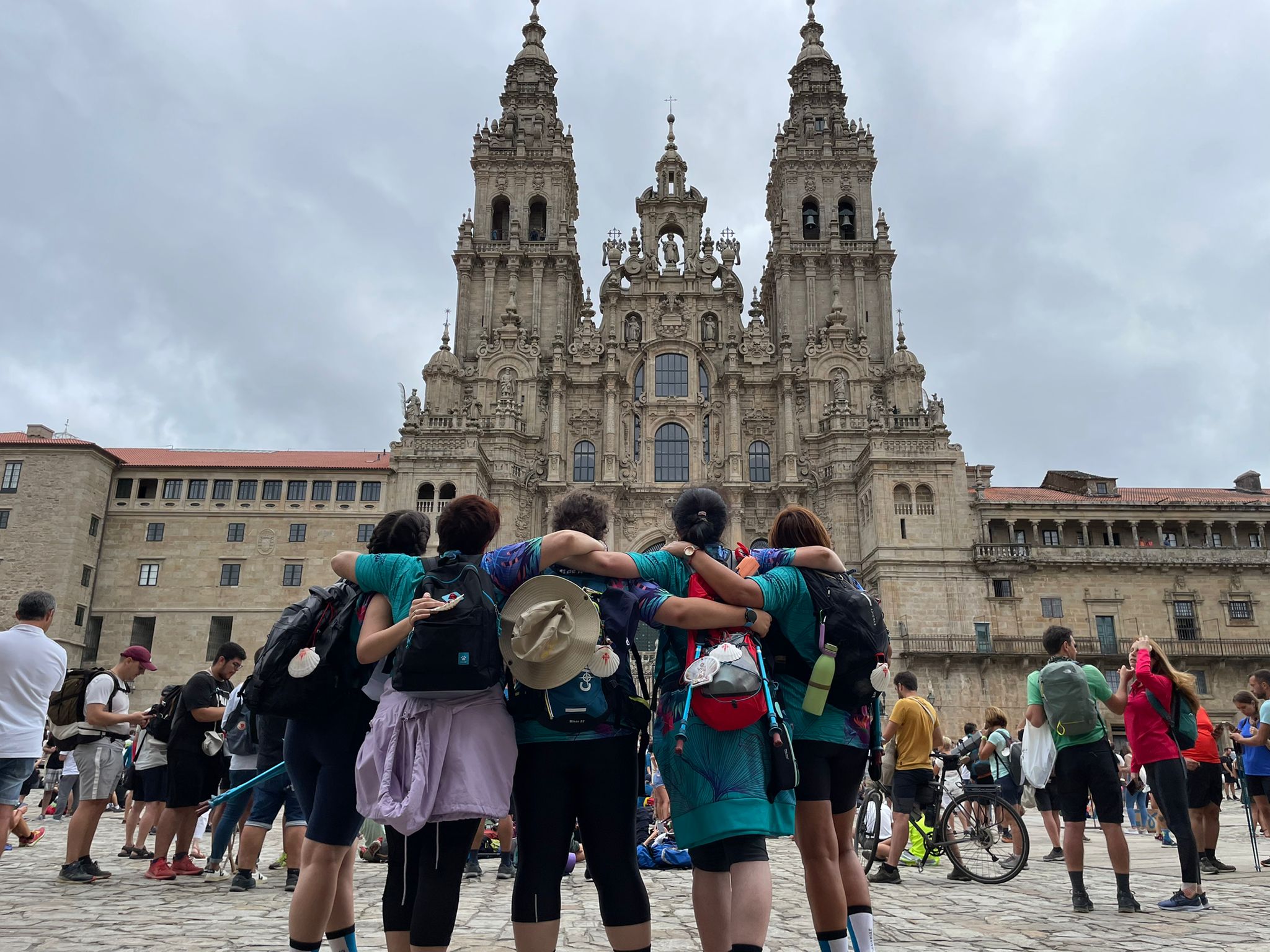
Excitement and strange mixed sensations. It is the last stage. We recommend that you start hiking early to take part in the pilgrimage, which is celebrated at 12:00 p.m. First we reach Lavacolla and continue climbing Monte do Gozo, where we can catch a glimpse of the long-awaited cathedral from a distance. Finally the Plaza del Obradoiro and the well deserved personal satisfaction of having reached this point.
Accommodation in Santiago.
Santiago de Compostela
Check out and end of our services.

Room with private bathroom
Breakfast included
Luggage transport for each stage on the way (max. 20 kg – 1 piece of luggage per person)
Guided Tour in Santiago de Compostela (old town)
Galician cheese tasting in Santiago
24-hour emergency line
Detailed information with stage maps
Pilgrim pass
Pilgrim scallop
Travel Insurance

Half board supplement: 25€ / person / night
Private transfer to Roncesvalles: on request
Private transfer to the airport: on request
One day tour Santiago – Fisterra: on request
One day tour Santiago – Rías Baixas & Wine Tasting: on request
One day tour Santiago – Rías Baixas, Wine Tasting & Boat Trip: on request
One day Tour Santiago – Catedrales Beach (Monday, Wednesday, Saturday): on request
One day Tour Santiago – Ribeira Sacra (Tuesday, Thursday, Saturday): on request
Extra piece of luggage: €8 per stage and piece of luggage (maximum 20 kg)
Extra nights: on request
Travel cancellation insurance
Camino de Santiago with Support
Camino francés from Roncesvalles to Santiago

Starting at 2985 € *
Price per person in a double room
Price per person, based on double occupancy.