Long before printed maps, travel guidebooks, or mobile apps existed, there was already a book that taught pilgrims how to reach their destination, which routes to follow, what dangers to avoid, and what wonders they would encounter along the way.
That book was written in the Middle Ages, and its mission was clear: to guide devoted travelers to Santiago de Compostela Cathedral along the Camino de Santiago.
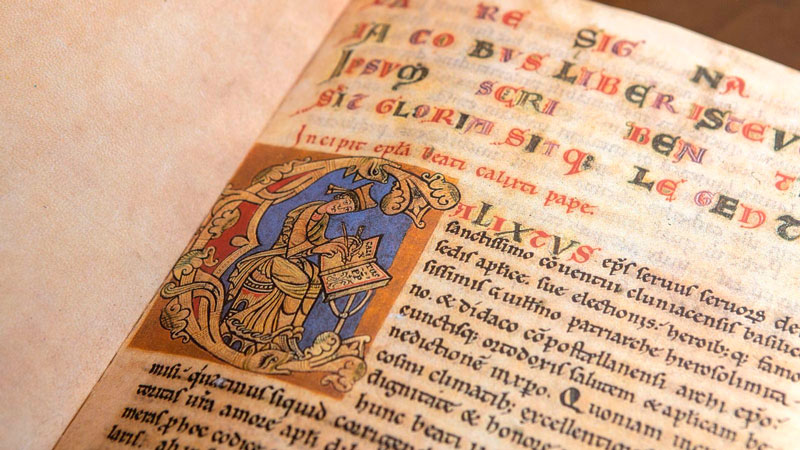
Today, the Codex Calixtinus is considered not only the most famous manuscript connected to the Camino de Santiago but also the first travel guide in European history. It is a monumental work that blends faith, literature, music, medieval epic storytelling, religious propaganda, and practical advice for pilgrims.
Written in Latin during the 12th century, the manuscript is preserved in the archive of Santiago de Compostela Cathedral, where it is protected under strict security measures.
A book created to make Santiago a spiritual center of Europe
The full title of the work is Liber Sancti Iacobi (Book of Saint James), although it became widely known as the Codex Calixtinus due to its false attribution to Pope Callixtus II.
In reality, its author—or authors—remain unknown. However, scholars believe it likely originated in France and was closely connected to the influential Order of Cluny.
The project was promoted by Diego Gelmírez, the powerful archbishop who played a decisive role in establishing the international prestige of Santiago de Compostela during the Middle Ages.
His goal was ambitious: to consolidate Santiago as the second great center of Christianity after Rome and to provide religious, cultural, and political legitimacy to the growing pilgrimage along the Camino de Santiago.
The Codex was not written all at once. Its compilation likely took more than forty years, from the 1120s to the 1170s, gradually expanding until reaching its final form with liturgical texts, stories, and even a musical appendix containing some of the earliest examples of Western polyphony.
Five books that built the world of the Camino de Santiago
The Codex Calixtinus is organized into five books, each designed with a specific purpose within the broader project of promoting devotion to Saint James the Greater and strengthening the pilgrimage tradition.
Book I: liturgy and spirituality
This is the longest section of the manuscript. It contains masses, sermons, hymns, blessings, and liturgical texts dedicated to Saint James.
One of the most notable texts is the famous sermon Veneranda Dies, which explains the deeper meaning of medieval pilgrimage: walking as a spiritual, penitential, and communal journey.
This section shows that the Camino de Santiago was never just a physical journey—it was a theological experience.
Book II: the miracles of Saint James
The second book gathers twenty-two miracles attributed to Saint James, reported from different regions of Europe.
Many of these stories are directly connected to the Camino de Santiago and the dangers pilgrims faced during the Middle Ages, including:
- Injustice
- Illness
- Shipwrecks
- Imprisonment
These accounts reinforced faith in the Apostle’s protection and encouraged believers to undertake the long and risky pilgrimage under his spiritual protection.
Book III: the arrival of Saint James’s body in Galicia
This section recounts the famous Translatio, the story of how the body of Saint James was transported from Jerusalem to Galicia after his martyrdom.
The narrative combines biblical elements, oral traditions, and medieval symbolism. Its purpose was to justify the historical presence of the Apostle’s tomb in Santiago de Compostela and reinforce the legitimacy of the pilgrimage destination.
Book IV: Charlemagne and the liberation of the Camino
The fourth book moves into the realm of epic storytelling.
It narrates the legendary adventures of Charlemagne and his knight Roland, who supposedly fought Muslim forces to liberate the Camino de Santiago.
This narrative, known as the Pseudo-Turpin Chronicle, is historically inaccurate but became extremely popular across medieval Europe, circulating in hundreds of copies.
Its goal was clear: to link the legendary figure of Charlemagne with the spiritual importance of Santiago.
Book V: the first travel guide in Europe
The fifth book is the most famous section of the Codex Calixtinus and the reason it is widely considered Europe’s first travel guide.
It describes in remarkable detail the French pilgrimage routes and the Camino Francés in Spain, including information about:
- Stages of the journey
- Cities and villages along the route
- Sanctuaries and relics
- Local customs
- Typical foods
- Potential dangers
- Character of local populations
- Descriptions of the Romanesque Santiago Cathedral
The guide is generally attributed to the French cleric Aymeric Picaud, who wrote from the perspective of personal pilgrimage experience.
Surprisingly modern in tone, the text combines practical travel advice with cultural observations, making it an invaluable resource for understanding the medieval Camino de Santiago.
This section has also played a key role in the modern revival of the Camino.
Music for Saint James: the first european polyphony
The Codex Calixtinus also includes a musical appendix with 21 compositions, representing some of the earliest examples of Western polyphonic music.
Among them is the famous Dum pater familias, considered the oldest preserved pilgrimage song.
This reveals that Santiago de Compostela was not only a religious center but also an important cultural and musical hub, connected to major artistic movements across medieval Europe.
Through the diffusion of the Codex Calixtinus, the Camino de Santiago became a truly continental pilgrimage route, attracting travelers from all over Europe and strengthening the cosmopolitan character of medieval Compostela.
The modern rediscovery of the Codex Calixtinus
After centuries of continuous use until the 16th century, the manuscript eventually fell into obscurity.
It was rediscovered in the 19th century by Antonio López Ferreiro and later studied and promoted by Fidel Fita and Aureliano Fernández Guerra.
Since then, historians across Europe have studied the manuscript extensively, recognizing it as one of the four most valuable codices preserved by the Spanish Church.
The theft that shocked the Camino
Many people first heard about the Codex Calixtinus in 2011, when it was stolen from Santiago de Compostela Cathedral.
On July 7 of that year, its disappearance was confirmed, launching an investigation that felt like something out of a crime novel.
For months, authorities suspected the manuscript had been stolen for the international black market.
However, about a year later, the Codex was discovered in a garage in O Milladoiro, hidden inside a sack of animal feed and wrapped in newspapers.
The thief turned out to be José Manuel Fernández Castiñeiras, a former electrician at the cathedral who had been dismissed and held resentment toward the institution.
Investigators also discovered around one million euros in cash, believed to have been stolen from donation boxes inside the cathedral.
The story inspired books, documentaries, and even a TV series on RTVE Play.
Today, more than a decade later, the Codex Calixtinus remains in the cathedral archive—its original location—but under extremely strict security measures.
Visitors can see a facsimile copy in the cathedral’s chapter house, while the original manuscript remains protected as one of the most valuable documentary treasures of the Spanish Church.