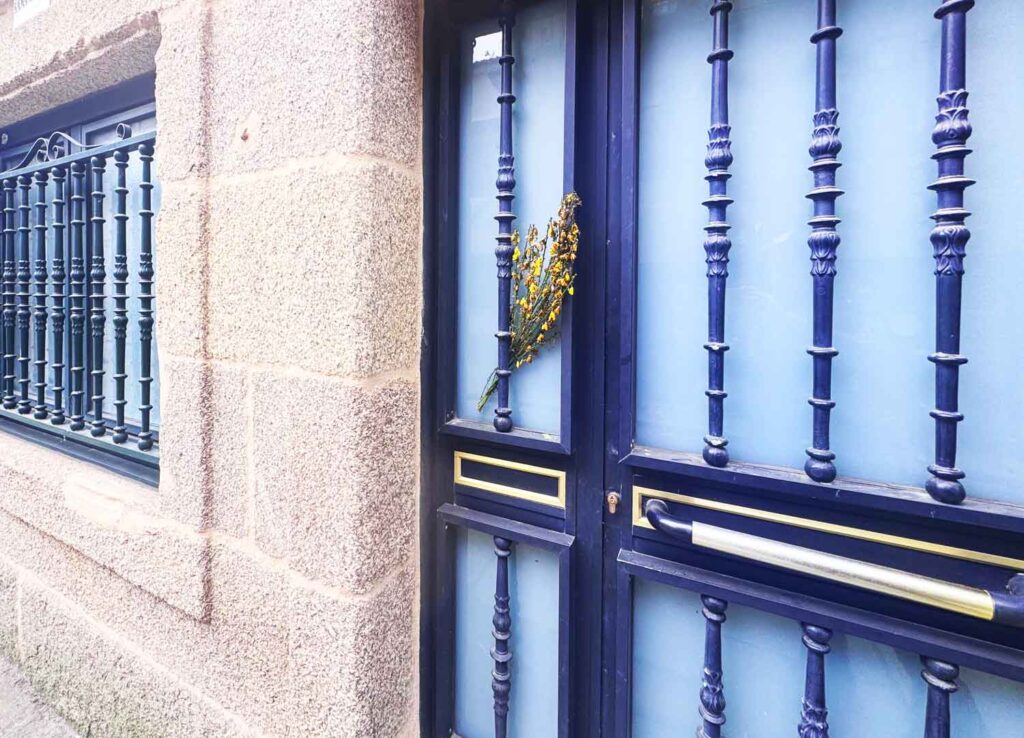
You’ve been walking for several days toward Compostela, enjoying the endless green landscapes of Galicia, its tiny villages with granite houses, the scent of eucalyptus and damp earth. Suddenly, something catches your eye: a bunch of yellow-flowered branches hanging on the door of a house. Then you spot another one on the bumper of a car. Another tied to the rearview mirror of a van. If you are walking the Camino de Santiago along the coast, you may even see them on fishing boats. Naturally, you start wondering why.
Well, here’s the answer.
Welcome to one of Galicia’s oldest and most vibrant traditions: Os Maios.
Xesta, the flower of protection
What you are seeing on doors and vehicles is called xesta, known in English as Scotch broom or common broom (Cytisus scoparius). It is a shrub commonly found throughout the hills and trails of Galicia, and between April and July it bursts into intense yellow bloom, painting the landscape gold.
During May, when thousands of pilgrims walk the Camino de Santiago — also known internationally as the Saint James Way — xesta is in full bloom, making it impossible to miss.
But this is Galicia, a land of ancient magic and superstition, so xesta is not just decorative. It is believed to protect.
According to Galician tradition, placing branches of xesta at the entrance of a house, on a fishing boat, or in a car before dawn on May 1st keeps negative forces away as the new month begins.
As elders from the Rías Baixas say, it is done “so that May cannot enter, nor any evil spell take hold.” In other words, to keep bad luck, the evil eye, and dark spirits from finding their way into your life during the month ahead.
What are “Os Maios”?
The Festa dos Maios is one of Galicia’s oldest celebrations. Its origins date back to the pre-Roman civilizations of northwestern Iberia, with possible links to the Celtic festival of Beltane — celebrated on the night of April 30th to May 1st and marking the beginning of the pastoral summer — as well as to the Roman worship of Maia, goddess of fertility and spring. Some ethnographers have even connected the conical shapes of the festival structures with ancient Celtic ritual mounds or burial monuments.
What Galicians call maios are elaborate vegetal structures built from wooden frames covered with moss, fennel, xesta, and wildflowers, usually shaped like cones or pyramids.
At the top, there is almost always a cross, because in Galicia religion and superstition walk hand in hand.
These creations parade through towns and villages during the first days of May, accompanied by traditional songs known as coplas, often humorous or satirical, delighting locals of all ages.
The materials used to build Os Maios must always be natural and, according to the oldest traditions, ideally “stolen,” as the ritual once required.
There are two main types of maios: the traditional cone- or pyramid-shaped structures — especially famous in Ourense, where some can exceed five meters in height — and the more artistic versions, which recreate granaries, stone crosses, bridges, animals, boats, or even human figures with remarkable creativity.
In coastal towns such as Marín, many maios naturally take the shape of fishing boats.
A Galician tradition that has survived everything
What makes Os Maios truly extraordinary is not only their age, but their ability to survive through centuries of change.
The tradition endured Romanization, medieval Christianization, social transformations, and modernity itself. Yet every spring, Galicia still dresses in yellow.
In the past, farmers decorated cattle horns and farming tools with xesta branches. Today the gesture remains essentially the same: invoking protection, celebrating nature’s rebirth, and finally shutting the door on winter.
In the city of Ourense, the Festa dos Maios was officially declared a Festival of National Tourist Interest in 2001. In Pontevedra, Vilagarcía de Arousa, Redondela, Marín, Portonovo, and dozens of villages across Galicia, maios competitions and traditional songs continue to bring entire communities together to celebrate the arrival of spring.
The Camino de Santiago and Os Maios: spirituality and superstition
For pilgrims walking the Camino de Santiago in spring, encountering Os Maios is one of those unexpected experiences that makes the Saint James Way even more unforgettable.
Galicia is a land where the sacred, superstition, and everyday life blend together naturally; where pagan rituals and Christian traditions coexist without contradiction; where magic is simply part of life. As Galicians like to say: “haberlas, haylas” — witches may or may not be seen, but they definitely exist.
So, if you come across those yellow flowering branches hanging from a doorway, now you know that this humble xesta has been protecting the people behind that threshold for thousands of years.
And perhaps it is not such a bad idea to tie a small branch to your pilgrim backpack, just in case you would like a little extra protection for the rest of your Camino de Santiago journey.
Buen Camino!!!