
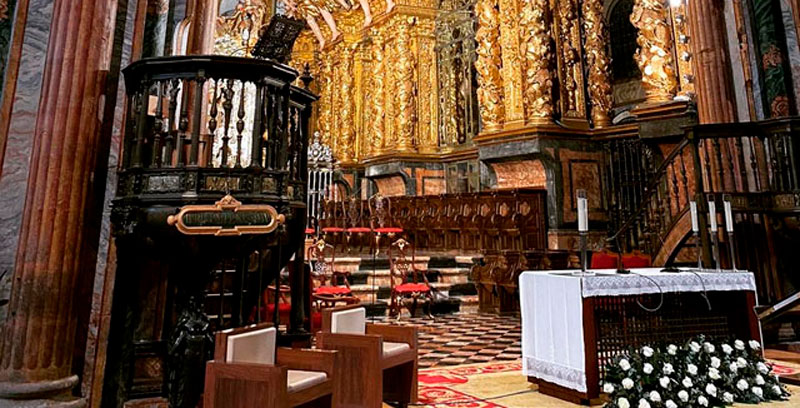
For centuries, the Cathedral of Santiago de Compostela has been a universal meeting point. A place where cultures, languages, personal stories, and spiritual motivations converge—first from across Europe and now from all five continents.
Every day beneath its vaulted ceilings, different accents can be heard and glances are exchanged among pilgrims who have walked hundreds of kilometers to reach the tomb of the Apostle Saint James in Compostela.
Now, this universal spirit is taking another step into the future. The Cathedral of Santiago has launched an innovative simultaneous translation service for the pilgrim mass in Santiago de Compostela using a mobile app powered by artificial intelligence.
This project blends tradition and technology so that no pilgrim misses part of this unique experience at the end of their Camino de Santiago because of language barriers or hearing limitations.
It is a tool designed to bring cultures and people together in one of the most emblematic spiritual spaces in the world.
The Cathedral of Santiago, always an international sanctuary
The Camino de Santiago is more international than ever. Data from the Pilgrim’s Office for 2025 clearly confirms this trend.
Although Spain remains the country with the highest number of pilgrims (43.44% of the total), more than half now come from abroad.
The main nationalities include:
United States (8.36%)
Italy (5.07%)
Germany (4.63%)
Portugal (4.34%)
United Kingdom (2.78%)
Mexico (2.30%)
Ireland (2.05%)
France (1.90%)
Australia (1.79%)
Canada (1.68%)
Brazil (1.60%)
Poland (1.58%)
South Korea (1.42%)
Argentina (1.30%)
Netherlands (1.28%)
Colombia (1.20%)
Taiwan (1.02%)
In total, more than half a million pilgrims received their Compostela certificate last year, coming from dozens of different countries with very diverse languages, cultures, and spiritual backgrounds.
The Pilgrim Mass, one of the most symbolic moments of the Camino de Santiago, brings together people every day who do not always understand the language in which the liturgy is celebrated.
For years, many pilgrims have participated devoutly without fully understanding the readings, the homily, or the prayers—enjoying mainly the multilingual greeting offered before the Mass.
This new app was created precisely to respond to that long-standing need.
At present, translations are available in German, English, French, Italian, and Portuguese. The technology is ready to expand gradually.
An app that preserves the solemnity of the Pilgrim Mass
The new simultaneous translation service works through a free mobile app, available on both the App Store and Google Play. Its design ensures that it does not interfere with the Pilgrim Mass or disrupt the atmosphere of reflection inside the cathedral.
Use is entirely individual. Each user only needs a smartphone and headphones. No additional installation or special devices are required.
The app offers two main modes:
Reading mode
Allows users to follow the Pilgrim Mass through real-time translated text displayed on their phone screen. Light and dark modes are available for visual comfort.
Audio mode
In this mode, the app translates the priest’s voice and transmits it through headphones using a natural-sounding voice, preserving the flow of speech and the spiritual experience.
In this way, pilgrims can fully participate in the celebration without breaking the silence or distracting other worshippers.
Artificial intelligence at the service of liturgy
Yes, artificial intelligence—now present in so many areas of daily life—has also reached the Pilgrim Mass of Santiago de Compostela.
At the heart of the system is a proprietary intelligent compression and synchronization algorithm. This is not a standard automatic translation tool, but one designed specifically for liturgical celebrations.
The algorithm analyzes natural pauses in speech, the priest’s rhythm, and the flow of the homily, automatically adjusting to reduce translation delay. As a result, the translated text or audio arrives almost simultaneously with the original voice.
This innovation greatly improves fluency and naturalness, overcoming one of the most common problems of simultaneous translation: excessive delay and loss of rhythm.
The app is also built to remain stable even when hundreds of users connect at the same time, something very common during peak pilgrimage seasons.
An inclusive and accessible tool
This project is not intended only for foreign pilgrims or those who speak languages other than Spanish. It also represents a significant step forward in accessibility.
People who are deaf or have hearing difficulties can follow the liturgy in written form on their phones, allowing them to participate fully without relying on others.
The Cathedral of Santiago thus responds to a daily reality: visitors with hearing impairments, international tourists, and pilgrims who—despite their devotion—do not understand the language used in the celebration. Until now, that language barrier limited their spiritual experience.
With this app, the Pilgrim Mass becomes a truly universal space.
Other uses of the app beyond the Pilgrim Mass
Although the application was designed primarily for liturgical celebrations, it can also be used for other events hosted by the Cathedral of Santiago:
Pastoral talks
Catechism sessions
Conferences
Institutional events
Cultural gatherings
This opens new possibilities for more open and participatory communication in a space that welcomes thousands of visitors every day.
The Cathedral of Santiago is reinventing itself without losing its identity. It remains a place of silence, prayer, and encounter—but now also a space where no one is excluded for linguistic or hearing reasons.
As the institution itself explains, the goal is “to help overcome language barriers and open doors to everyone who arrives, no matter where they come from, without losing the spiritual message or the sense of community.”
The Camino de Santiago adapts to the times
The Camino de Santiago has evolved over the centuries. From medieval pilgrims to those of the 21st century, the route has adapted to every era without losing its essence.
Today, pilgrims travel with mobile apps, digital reservations, and interactive maps—and now also with simultaneous translation for the Pilgrim Mass in Santiago de Compostela.
This project represents a modern, inclusive, and global Camino, where tradition and technology coexist naturally.
Buen Camino!