The Atlantic Origins of the Celts
A not-so-recent, though perhaps little-known, study from the University of Oxford, led by Professor Bryan Sykes, shed light some years ago on a fascinating link between Galicia and the British Isles. According to DNA analysis, most British Celts do not descend from Central European tribes, as was previously believed, but from coastal Iberian peoples who crossed the Bay of Biscay about 6,000 years ago.These ancient sailors from the northern part of the Iberian Peninsula – ocean-savvy fishermen – may have been the true genetic founders of what we now call the Celtic world.
This genetic connection strengthens the Galician legends that speak of Breogán, a mythical king of Brigantia (modern-day A Coruña), who is said to have built a tower so tall (the Tower of Hercules, perhaps?) that his son Ith could see Ireland from its top. Inspired by that vision, Breogán’s descendants are said to have crossed the sea to conquer the Emerald Isle, planting Celtic roots there.
Galicia, known in its anthem as the “Fogar de Breogán” (Home of Breogán) – a composition based on the poem Os Pinos by Eduardo Pondal, with music by Pascual Veiga – was not only a mythical birthplace, but also, it seems, a genetic cradle of Celtic culture.
Sykes’ research seems to give some scientific weight to this ancient legend, placing Galicia not at the fringe of the Celtic world, but at its very heart.
Finisterre and the Ara Solis: where the sun dies and myths are born
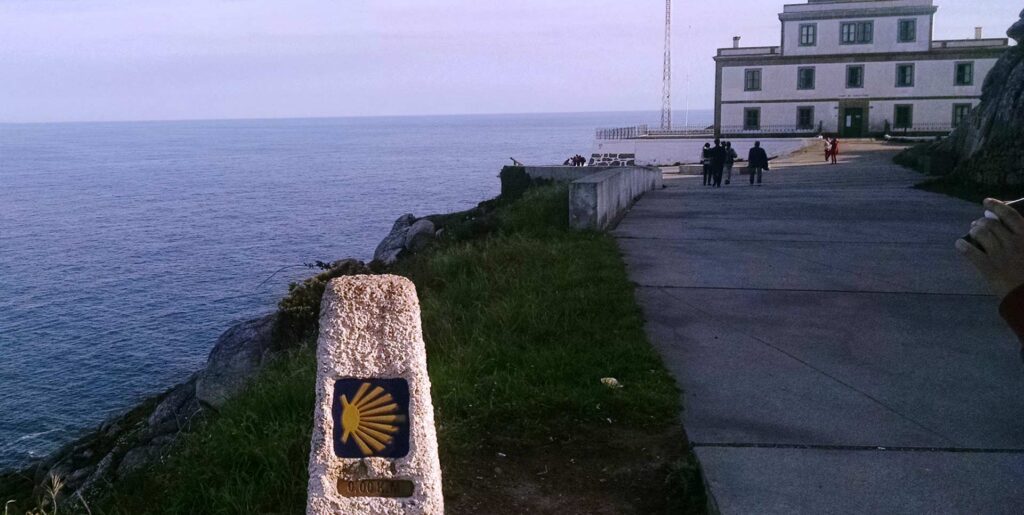
Long before the Camino de Santiago existed, Cape Finisterre was already a sacred site. For Celtic and pre-Roman peoples, this westernmost point of the continent was more than just geography – it was cosmology. The sun plunged into the ocean each night, and that moment was understood as a passage between worlds – a metaphor for death and rebirth.Atop the cape is believed to have stood the mythical Ara Solis, an altar dedicated to solar worship. According to classical authors like Pomponius Mela and Pliny the Elder, this sanctuary consisted of granite columns supporting a dome and was used by the Gallaeci (the ancient Galicians) to make ritual offerings to the sun.
Although no unequivocal archaeological remains of the Ara Solis have survived, its symbolic force endures in legends, folklore, and possibly even in Galicia’s coat of arms, where the chalice and host could be interpreted as Christianized versions of the ancient solar altar.
The Camino and Finisterre: a journey back to the origin
Many pilgrims who reach Santiago feel a deep inner pull to keep going. Not for tourism, nor tradition, but out of spiritual instinct. The Camino to Finisterre is not just an extension of The Way – it’s a return to the beginning: to the sea, the sun, the earth, and myth.The Camino de Santiago, as we know it today, is built upon a network of routes far older than the Christian pilgrimage. The paths leading to Finisterre were already used by the Celts for their own solar pilgrimages. So when today’s walkers continue their journey to the cape, they’re treading an ancestral path. There, watching the sun sink into the Atlantic, many feel a true sense of closure – an ending that is also a beginning.
The Ara Solis and the christianization of the End of the World
With the arrival of Christianity, the Ara Solis was reinterpreted as a symbol of spiritual conquest. Legend has it that it was none other than the Apostle James himself who destroyed the solar altar, marking the end of the ancient pagan rites and the triumph of the new faith.This overlay of beliefs – from Celtic sun worship to Christian symbolism of sunset as a passage to the afterlife – is a clear example of religious syncretism. And it’s this very fusion of traditions that gives Finisterre its spiritual power. The Camino doesn’t end here by accident. It ends (or begins) in a place where the sun disappears, where the sea opens the imagination, and where history and legend intertwine.
Galicia, Celtic Homeland of the Atlantic
Through its hillforts (castros), its language, music, rituals, and geography, Galicia keeps the Celtic spirit alive. Not as a distant memory, but as a living rhythm that pulses through our culture – in every celebration, every stone along the Camino, and every time we look out at the ocean that connects us to our northern kin.Modern science now gives us new confirmation that those old legends – of Breogán, of Ith, of Ireland, and the sea – weren’t so far off. That the Celts of Ireland and Scotland look south and see, reflected in their genetic mirror, Galicia. That history and the Celtic soul converge in this green corner of the Atlantic.
And at its most symbolic edge, where land gives way to ocean, Finisterre awaits.
The end of the earth.
The beginning of the eternal.
The altar of the sun.
And for many, the true destination of the Camino.