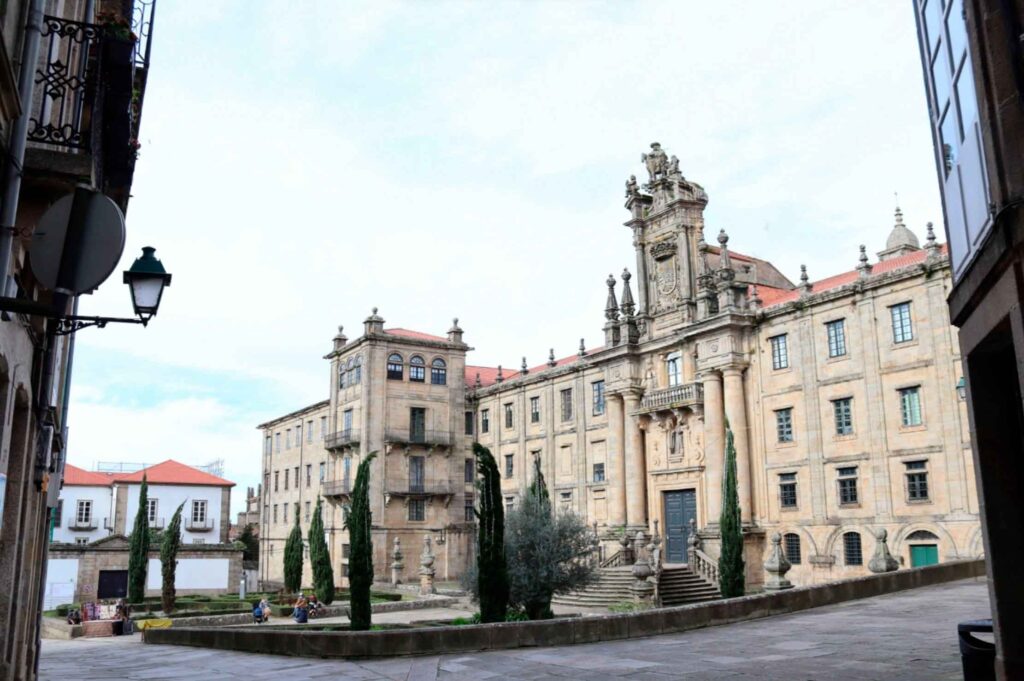
Facing the imposing Cathedral of Santiago de Compostela, in the Plaza de la Inmaculada —known locally as Praza da Azabachería— rises one of Galicia’s most stunning monumental complexes: the Monastery of San Martín Pinario.
With more than a thousand years of history, this monastery is today a true landmark for pilgrims completing the Camino de Santiago, and together with the Cathedral, it forms the most valuable Baroque ensemble in Galicia.
Few people know that the Monastery of San Martín Pinario is the second largest in Spain, surpassed only by El Escorial, and that in its time it was also the most prosperous and powerful monastery in Galicia.
Origins linked to the Apostle James
The history of the monastery is closely tied to the origins of the Camino de Santiago. According to tradition, after the discovery of the remains of the Apostle James the Greater in the 9th century, a community of Benedictine monks settled in a place called Pignario or Piñeiro—a name referring to an area of pine trees—next to the old chapel of Santa María de la Corticela, very close to the Apostle’s tomb. Their initial role was to guard the tomb of Saint James, and that small monastic nucleus was the seed of the vast complex we know today. From its beginnings, San Martín Pinario became part of the spirit of the Camino de Santiago: pilgrims arriving at the Cathedral found in it a place of rest, worship, and hospitality.History, growth, and transformation of the Monastery
The true development of the monastery began in 1494, when it came under the Congregation of Saint Benedict of Valladolid. This change marked a turning point: the monastery expanded its estates and priories, adopted a monumental scale, and became one of the most influential religious centers in the northwest of the Iberian Peninsula. Between the 16th and 18th centuries, it underwent a major architectural transformation. San Martín Pinario was practically rebuilt, combining Renaissance, Baroque, and Neoclassical styles. For centuries, it also housed the second-largest apothecary in Spain, where monks cultivated a wide range of medicinal plants in their botanical garden. The community grew to include as many as a thousand Benedictine monks—an indication of its scale and prosperity. With the Ecclesiastical Confiscations of 1835, the community was expelled, and the building took on new roles: major seminary, high schools, state offices, and guesthouse, reflecting its evolution from monastic life to public service. Today, the Monastery of San Martín Pinario hosts university classrooms, a seminary, a religious art museum, and accommodations for pilgrims and visitors. Despite the changes, it remains a spiritual and cultural symbol of Santiago—and an essential stop at the end of the Camino.Architecture and art: a visual journey through Galician Baroque
The Monastery of San Martín Pinario is a true architectural statement, where styles and eras coexist, reflecting the evolution of Galician art.- The main façade, conceived as a grand Baroque altarpiece, was designed in 1671 by the monk-architect Fray Gabriel de Casas.
- The church, consecrated in 1652, was designed by architect Mateo López, later enhanced by Bartolomé Fernández Lechuga, who created the splendid dome over the crossing.
- To enter the church, you must head to the Plaza de San Martín, on the west side of the complex—one of the most impressive spaces in the city.
- Inside, the church features a long nave covered by a barrel vault with false coffers, interconnected side chapels, and a Baroque walnut choir carved by Mateo de Prado between 1639 and 1647.
- Two cloisters complete the monumental complex: the Processional Cloister, begun in 1636 and finished in 1743, and the Offices Cloister—both outstanding examples of Baroque monastic architecture.
The facades of Compostela and the mark of the Pine Tree
If you stroll through Santiago de Compostela—especially around the San Pedro neighborhood—you might notice something curious: many facades bear a carved mark, often in the shape of a tree with the initials “SM.” These houses once belonged to the Monastery of San Martín Pinario, and the carved tree was a pine—symbol of Pignario, the monastery’s original name. Even today, these marks remain as evidence of the power and influence the monastery held over property and daily life in old Compostela.The Monastery’s connection to the Camino de Santiago
Few buildings are as closely linked to the Camino de Santiago as San Martín Pinario. Thanks to its immediate proximity to the Cathedral, many pilgrims, after reaching the Apostle’s tomb, continued on to the monastery to pray, rest, or give thanks for completing their journey. The Benedictine order was known for its hospitality: it offered assistance and refuge to travelers, continuing the tradition of welcome and care that defines the spirit of the Camino. In a way, the artistic grandeur of the building symbolizes the inner journey of the Camino itself: a spiritual path culminating in a work that transcends the earthly realm.What to see and how to visit the Monastery of San Martín Pinario
If you are walking the French Way, the Northern Way, the Primitive Way, or the English Way, you’ll pass right in front of the monastery just before reaching the Plaza del Obradoiro. When you arrive at the Plaza de la Inmaculada, take a moment to look to your right: before you rises one of the largest religious complexes in Spain, second only to El Escorial. Visiting hours (church + museum):- Monday to Friday: 10:00–14:00 and 16:00–18:00
- Saturdays: 10:00–14:00