A Rapa das Bestas is a centuries-old Galician tradition in which villagers round up wild horses from the mountains, cut their manes and tails by hand, treat them for parasites, and release them back to freedom. Held every first weekend of July in the village of Sabucedo (Pontevedra, Spain), it is one of Galicia’s oldest living festivals and has been officially declared a Festival of International Tourist Interest.
If there’s one thing worth talking about in Galicia during the summer, it’s festivals — and here, there’s no shortage of them. A Rapa das Bestas in Sabucedo is a celebration rooted in our most ancestral traditions, one you experience with your whole body: the smell of mountain brush and horse sweat clinging to your skin.
Every first weekend of July, a tiny village of barely 200 residents in the heart of the Tabeirós-Terra de Montes region becomes the stage for one of the oldest, most authentic, and most awe-inspiring traditions in Galicia.
At Rutas Meigas, we’ve always invited you to explore the Galician landscape — its trails, its forests, and its people. Few experiences capture the spirit of this land better than A Rapa das Bestas, a ritual where humans and wild horses meet, hand to hide, in a dance as old as Galicia itself.
What is A Rapa das Bestas?
The name “As Bestas” may ring a bell if you’ve seen The Beasts, Rodrigo Sorogoyen’s award-winning film — though here, we’re talking about horses, not the movie’s plot. A Rapa das Bestas, literally “the shearing of the beasts,” is the name given to one of the most distinctive traditions in Galician folk culture.
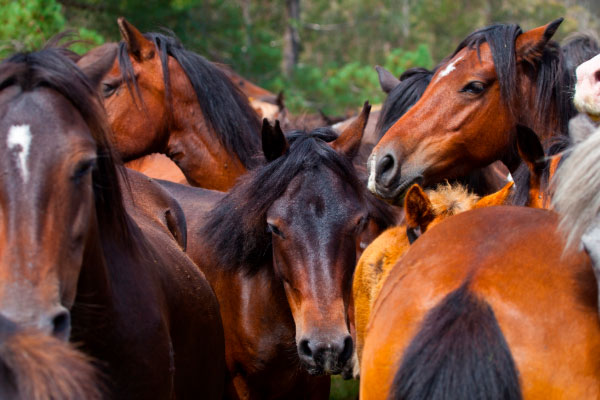
The ritual involves rounding up wild horses that live freely in the mountains, driving them into a circular stone enclosure called a curro, cutting their manes and tails, deworming them, treating any wounds, and marking them — before releasing them back into the wild.
This isn’t a show staged for tourists. It’s a centuries-old livestock management ritual that has evolved into one of Galicia‘s most recognizable cultural markers. The Greek geographer Strabo described, over 2,000 years ago, how the peoples of the northwestern Iberian Peninsula rounded up their wild horses with shouts and dramatic gestures. That same scene, with a few modern nuances, still plays out today.
The stars of the Rapa das Bestas are purebred Galician horses (caballo de pura raza gallega) and mixed Galician-breed horses — small, hardy, and extraordinarily resilient animals that have survived in the wild for centuries across Galicia’s hills. Their role goes far beyond folklore: by grazing on gorse, heather, and scrubland, these wild horses play a key role in wildfire prevention by keeping Galicia’s mountains clear of overgrowth. Caring for them, controlling their population, and keeping them healthy is, at its core, the real reason the rapa exists — and in an era of climate change, that role has never been more important.
A tradition celebrated across Galicia
While Sabucedo is by far the most famous, A Rapa das Bestas isn’t an isolated phenomenon. In fact, some of the oldest capitals in Santiago de Compostela Cathedral already depict a medieval aloitador (horse wrestler) grappling hand-to-hand with a horse.
Today, more than a dozen curros across the Galician countryside — mostly in the mountain ranges of southern Pontevedra — hold their own version of the rapa between spring and summer:
- Curro de Valga and Curro de Torroña, in Oia (Pontevedra) — May and June
- Curro de Mougás, also in Oia — mid-June
- Curro de Morgadáns and Curro de San Cibrán, in Gondomar, on the slopes of Mount Galiñeiro
- Curro da Capelada, in Cedeira (A Coruña)
- Curro Campo do Oso, in Mondoñedo (Lugo)
- Curro de Candaoso, in Viveiro (Lugo) — also officially declared of Tourist Interest
- Curro de Amil, in Moraña, and Curro de Monte Castelo, in Cotobade — held in July
A Rapa das Bestas reflects the communal spirit of Galicia‘s villages, respect for an animal that roams free nearly all year, and an awareness of preserving a bond between people and mountain that dates back at least to the Iron Age.
Still, none of these other curros has reached the fame, scale, or symbolic weight of Sabucedo’s.
Sabucedo: the Origin of a legend over three centuries old
The parish of San Lourenzo de Sabucedo, part of the municipality of A Estrada in the province of Pontevedra, near Santiago de Compostela, is a tiny place — barely six square kilometers — that sees its population multiply many times over during the first weekend of July, as visitors arrive from across Galicia, Spain, and around the world.
Sabucedo’s rapa has ancestral roots, and like most age-old traditions, its exact origin blurs the line between history and legend. Oral tradition tells of a plague that devastated the region centuries ago, when two sisters promised San Lourenzo, the parish’s patron saint, that they would donate two of their horses if the disease came to an end. The plague subsided, the promise was kept, and since the Church could own animals but not care for them day to day, local villagers took on the task themselves — gathering, marking, and tending to the horses once a year, while letting them roam free the rest of the time.
The earliest written records describing a rapa similar to today’s ceremony date back to 1682, making Sabucedo’s tradition one of the oldest continuously living customs in all of Galicia.
The Curro de Sabucedo: Galicia’s purest Rapa
What sets the Curro de Sabucedo apart from every other is how the confrontation between human and horse unfolds. No ropes, lassos, or sticks are used here. Instead, the aloitadores — young men, and increasingly young women, from Sabucedo — face the animals using only their bare hands and a knowledge of horses passed down through generations. It’s likely the only curro in Galicia where the struggle happens entirely hand-to-hand, body-to-body.
The current enclosure was built in the 18th century, adjoining the parish church itself. Its stone walls and semicircular stands, arranged like a small amphitheater, let hundreds of spectators watch the action up close without interfering — a piece of vernacular architecture that has served the same purpose for three centuries.
A Baixa: the search in the mountains
It all begins before dawn, when the people of Sabucedo climb Montouto mountain to locate the horse herds that have spent the year grazing freely. Guided by their deep knowledge of the terrain and the animals’ behavior, they slowly encircle the herds and, with patience and skill, drive them down toward the village.
O Curro: the hand-to-hand struggle
Once the wild horses are inside the enclosure, the festival reaches its climax. The aloitadores and aloitadoras work in small teams of three. Two of them handle the horse’s head, working to hold and subdue the animal, while the third controls the tail to avoid kicks. It’s an intense, full-body struggle — equal parts strength and technique — that ends with the cutting of the horse’s mane and tail, deworming, and a health check. The youngest foals are separated first to keep them safe during the wrestling.
Os Aloitadores & as Aloitadoras: guardians of a living tradition
Being an aloitador in Sabucedo is a role passed down through generations — one you grow up watching in a father, an uncle, or a neighbor, and one that demands an intimate understanding of horse behavior that only comes with years of experience. Each edition of the rapa pays tribute to these men and women, the true guardians of a tradition they carry, quite literally, on their shoulders, generation after generation.
A Rapa das Bestas de Sabucedo: Festival Program
The celebration has been officially declared a Festival of International Tourist Interest.
The program unfolds over four days:
- Day 1: A tribute gala honoring the aloitadores and aloitadoras
- Day 2: Mass in honor of San Lourenzo, followed by A Baixa — the trip up the mountain to round up the horses
- Saturday: The horses arrive in Sabucedo, and the first major curro session takes place in the afternoon
- Sunday: The experience repeats, typically with a midday session and another at dusk
- Monday: The festival closes with the final curro session and the horses’ return to the mountains
Between curro sessions, the whole village turns into one big street party — as only Galicia can do it — with parades, traditional bagpipe (gaita) music, concerts as part of the Rapasons festival, and food and craft stalls lining the streets.
Each edition brings together more than 600 wild horses across roughly 14 herds — a display of strength and community organization that’s as hard to match as it is to forget. A ticket is required to watch the curro sessions from the stands, so it’s worth planning ahead if you want to experience it up close.
Discover Galicia with Rutas Meigas
Galicia is full of places waiting to be discovered — more than you’d ever imagine.
Tabeirós-Terra de Montes is a land of forests, rivers, and villages, perfect for unhurried hiking and exploration, and it sits just a short distance from Santiago de Compostela.
Pairing the end of your Camino de Santiago with a visit to Sabucedo, exploring Padrón — one of the towns most closely tied to the Jacobean tradition — or hiking a route through the Serra do Barbanza, is the best way to understand why this land remains so deeply connected to its traditions.
Rutas Meigas | Specialists in Camino de Santiago and hiking in Galicia | rutasmeigas.com