
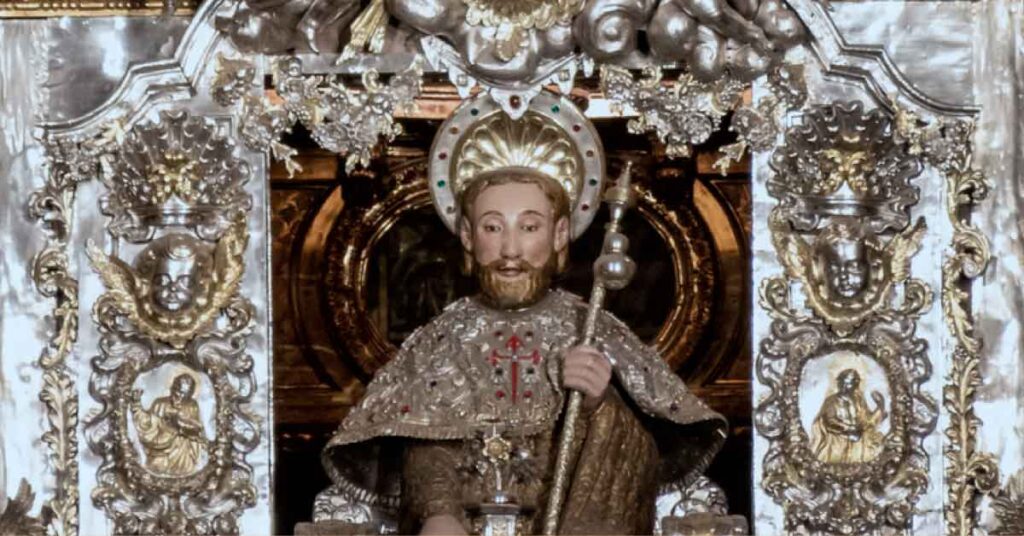
The Apostle’s Feast in Compostela usually begins in mid-July and always concludes on July 31.
The most popular moment of these celebrations is perhaps the fireworks display on July 24, known locally as the “Night of Fireworks”. But there is another very special tradition that takes place on July 25, the Apostle’s feast day, marking the pinnacle of the festivities.
On July 25, the Solemnity of St. James, a ceremonial Mass and the National Offering are held, presided over by the archbishop. But who performs the Offering to the Apostle? Traditionally, it is the King of Spain—currently, King Felipe VI.
So, where does this tradition come from, and does the King really come to Compostela every year for this event?
When did the Offering to Apostle St. James begin?
During the Apostle’s Feast on July 25, Santiago de Compostela Cathedral becomes the setting for one of Spain’s most significant ceremonies: the National Offering to Apostle St. James. This tradition, established by King Philip IV in 1643, symbolizes the Spanish monarchy’s devotion to the Patron Saint of Spain and has continued, with few interruptions, over the centuries.Origins of the National Offering to Apostle St. James
As mentioned, the National Offering to St. James was instituted by Philip IV in June 1643. This act was a response to the challenges faced by Compostela and St. James’s patronage since the late 16th century. During this period, Compostela’s traditions and St. James’s status as Spain’s patron saint were questioned. Influential sectors pressured the Crown to replace him with Archangel Michael as the patron. The establishment of the Offering served as a gesture of devotion from the monarch to the Apostle, acknowledging the blessings received by the king and his predecessors. The first representative designated by the king to make the Offering was Martín de Redín, Captain General of Galicia and Grand Prior of Navarre. Since then, the ceremony has been held almost uninterruptedly, except in 1854 due to a cholera epidemic. Initially set at a thousand gold escudos, the Offering represented a substantial amount. And it became a significant source of income for Santiago Cathedral during the 18th and 19th centuries. Until 1812, the Offering remained largely unchanged. However, the Cádiz Courts proposed its abolition. Nonetheless, King Ferdinand VII’s conservative stance prevented this measure from being enacted. In 1869, during the revolutionary government, the financial contribution was annulled, interpreted in Compostela as a de facto suppression. However, political fluctuations allowed its continuity, albeit with less pomp.Kings and Delegates in the National Offering to St. James
Although Philip IV intended to present the Offering himself, it wasn’t until 1877 that a monarch—King Alfonso XII—visited Santiago and performed this ceremony. King Alfonso XIII continued this tradition in 1909, during a Holy Year. Since 1976, King Juan Carlos designated royal delegates, often the main authorities of Galicia or the mayor of Compostela.The Ceremony of the National Offering
The Offering ceremony involves the solemn entrance of the designated delegate or the King himself into Santiago Cathedral and the symbolic presentation of the Offering during the Mass. The delegate delivers an invocation to the Apostle, to which the Archbishop of Compostela responds. This act symbolizes the monarchy and state’s devotion and respect for Apostle St. James, reinforcing the historical and spiritual bonds between the nation and its patron.What happens if the King cannot attend the Offering?
When the King of Spain cannot personally attend the Offering, he appoints a royal delegate to perform the ceremony on his behalf. This practice has been common throughout history, especially during periods of political instability or when the King’s duties prevent him from attending. Royal delegates are typically prominent figures in Galician politics and society, such as:- The President of Galicia’s Xunta
- The Mayor of Santiago de Compostela
- The President of the Galician Parliament.